
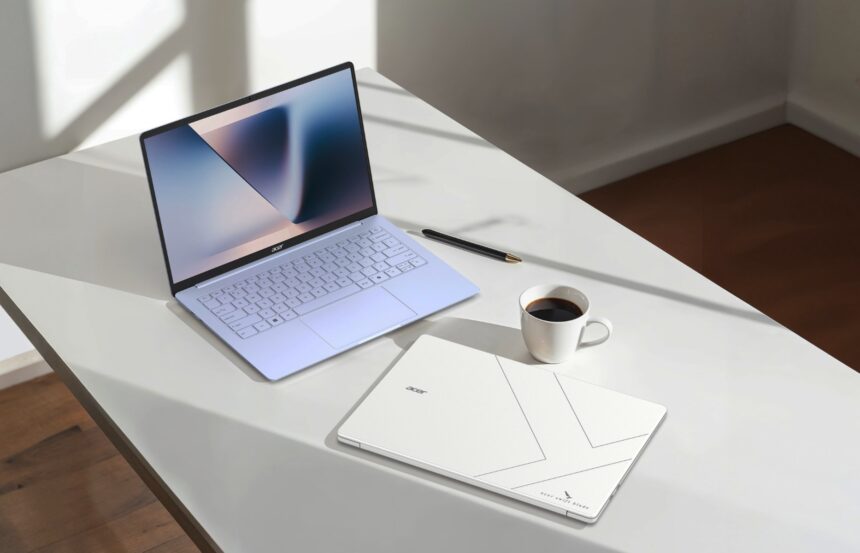
Acer has taken a different route in its latest attempt to compete with lightweight laptops such as the MacBook Air. Rather than focusing primarily on higher performance or additional ports, the company has put portability at the center of its new Swift Blade 14, a 14-inch Windows 11 laptop that weighs just 799 grams.
Unveiled at IFA 2026, the Swift Blade 14 combines Intel Core Series 3 processors with display options that include a 3K OLED panel. Its exceptionally low weight puts it among the lightest mainstream Windows laptops currently announced.
A 14-inch laptop weighing less than 800 grams
Acer achieves the Swift Blade 14’s weight through a combination of magnesium-aluminum alloy and carbon fiber, with the latter used on the lid and bottom of the machine. The laptop starts at 12.9mm thick, although some OLED configurations are slightly thicker.
The difference becomes more apparent when compared with Apple’s latest MacBook Air. The 13-inch MacBook Air with the M5 chip weighs approximately 1.23kg, making the Acer around 431 grams lighter. Apple’s machine is thinner, however, measuring 11.3mm at its thinnest point.
The Swift Blade 14 also has a substantial advantage over Microsoft’s 13-inch Surface Laptop, which weighs roughly 1.22kg. For users who carry a laptop, charger and accessories throughout the day, cutting more than 400 grams from the overall load could make a meaningful difference.
Intel processors and a 3K OLED option
Acer plans to offer several processor configurations, starting with the Intel Core 3 304 and extending to the Core 7 350. All models come with 12GB of LPDDR5-6400 memory, while storage can reach 1TB through a PCIe 4.0 NVMe SSD.
The 14-inch display will be available in several configurations. The flagship option is a 2880 x 1800 OLED panel with a 90Hz refresh rate, 400 nits of brightness and full coverage of the DCI-P3 color gamut.
Buyers will also be able to choose a 1920 x 1200 OLED display running at 60Hz or an IPS panel with the same resolution.
The aggressive weight target does come with compromises elsewhere. The Swift Blade 14 has a 50Wh battery, Wi-Fi 6 and Bluetooth 5.3. Its physical connections include three USB-C 3.2 Gen 1 ports and a 3.5mm headphone jack. Acer’s listed specifications do not include USB-A, HDMI or Thunderbolt 4.
Battery life remains one of the biggest unanswered questions. A laptop this light could be particularly appealing to frequent travellers, but its portability will be less valuable if the relatively small battery results in limited endurance.
The laptop does not qualify as a Copilot+ PC
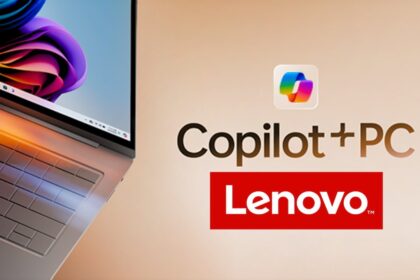
Despite Acer highlighting AI capabilities and the presence of an NPU in the new Intel processors, the Swift Blade 14 has not been announced as a Copilot+ PC.
The main obstacle is memory. Microsoft’s current Copilot+ requirements include at least 16GB of RAM, 256GB of storage and an NPU capable of more than 40 TOPS. Acer’s Blade 14 instead comes with 12GB of RAM.
That distinction matters because an NPU can accelerate certain AI workloads without automatically providing access to the full range of Copilot+ features. Functions such as enhanced Windows Search and Click to Do are tied to Microsoft’s Copilot+ hardware requirements.
The decision is somewhat unusual for a premium Windows laptop launching in late 2026, particularly as Microsoft continues to position Copilot+ as an important part of the high-end PC experience.
Acer also introduces the Swift Air 16
Acer’s announcement also includes an updated Swift Air 16, which uses the same Intel Core Series 3 family.
The larger model weighs around 1.5kg and measures between 13.3mm and 13.5mm in thickness. It can be configured with up to 16GB of LPDDR5x memory and 512GB of storage, while its 70Wh battery should provide considerably more capacity than the Blade 14.
The Swift Air 16 will also offer a high-end 2880 x 1800 OLED display with a 120Hz refresh rate. Acer claims a total platform performance of up to 40 TOPS, though that figure should not be conflated with Microsoft’s requirement that the NPU itself exceed 40 TOPS for Copilot+ certification.
The new Intel-based model should also be distinguished from Acer’s earlier Swift Air 16 with Ryzen AI. That version is marketed as a Copilot+ PC and can weigh under 1kg when equipped with an IPS display.
Acer says both the Swift Blade 14 and the new Swift Air 16 will reach EMEA markets in December 2026. Exact configurations and availability will depend on the individual country.
The company has not yet announced Spanish pricing or confirmed which configurations will be sold there. Prices will be revealed at a later date, making it difficult to determine how competitive the Blade 14 will be against Apple’s MacBook Air or Microsoft’s higher-end Surface models.
Acer’s biggest selling point is its weight
At 799 grams, the Swift Blade 14 has an immediately compelling advantage. A full-size 14-inch Windows laptop that weighs less than 800 grams could be particularly attractive to students, commuters and frequent travellers who consider portability more important than having every possible feature.
However, Acer has clearly made compromises to reach that figure. The 12GB memory configuration is unusual for a laptop launching in late 2026, while the absence of Copilot+ certification, limited connectivity and relatively small 50Wh battery could all influence the buying decision.
The lack of newer wireless and connectivity technologies also raises questions because some of those omissions have little direct relationship to the laptop’s weight.