
AMD completely reshaped the desktop processor market with the introduction of the Zen architecture in 2017. After years of struggling to compete with Intel’s dominance, the launch of the first Ryzen processors marked the beginning of one of the biggest turnarounds in PC hardware history.
Built around a brand-new CPU architecture, Ryzen delivered massive improvements in performance, power efficiency, and multi-core processing. It also forced Intel to rethink its own roadmap, leading to more competition and faster innovation across the processor industry.
Today, AMD’s Zen architecture has evolved through five generations, powering everything from budget desktop PCs to high-end gaming systems, workstations, and AI-powered laptops.
Here’s everything you need to know about AMD’s Zen architecture, its evolution, key technologies, and how it compares with Intel processors.
What Is AMD Zen Architecture?
Zen is AMD’s CPU microarchitecture that defines how Ryzen processors execute instructions, manage cache, communicate internally, and process workloads.
Unlike manufacturing processes such as 7nm or 5nm, architecture focuses on the internal design of the processor. It determines how efficiently the CPU handles instructions, manages power consumption, and delivers performance across different applications.
Before Zen, AMD relied on the Bulldozer and Piledriver architectures used in the FX processor lineup. Those chips struggled with poor single-core performance, high power consumption, and misleading core designs that ultimately led to legal challenges for the company.
Zen completely changed AMD’s direction.
The first-generation Ryzen processors were introduced:
- More than 50% improvement in Instructions Per Clock (IPC)
- Significantly better power efficiency
- Higher core counts across every price segment
- Simultaneous Multithreading (SMT), AMD’s equivalent of Intel’s Hyper-Threading
The result was a processor lineup that offered excellent value for gamers, creators, and professionals alike.
Evolution of AMD Zen Architecture
Since its debut, AMD has continuously refined the Zen architecture with each Ryzen generation.
Zen (Ryzen 1000)
Released in 2017, the original Zen architecture powered the first Ryzen processors and competed directly with Intel’s 7th Generation Kaby Lake CPUs.
AMD dramatically increased core counts, offering up to 8 cores and 16 threads, while Intel’s mainstream flagship still featured only four cores and eight threads.
This move fundamentally changed expectations for desktop processors and pushed Intel to respond in future generations.
Zen+ (Ryzen 2000)
Zen+ refined the original design by moving from a 14nm to a 12nm manufacturing process.
Key improvements included:
- Higher clock speeds
- Reduced cache latency
- Better power efficiency
- Improved overall stability
While the performance gains were modest, Zen+ helped AMD strengthen its position against Intel’s Coffee Lake processors.
Zen 2 (Ryzen 3000 and Ryzen 4000)
Zen 2 represented AMD’s biggest architectural leap since the original Ryzen launch.
Major improvements included:
- Transition to a 7nm manufacturing process
- Introduction of the chiplet design
- Support for PCIe 4.0
- Larger L3 cache
- Around 15% higher IPC than the original Zen architecture
The Ryzen 3000 series also introduced Ryzen 9 processors with up to 16 cores and 32 threads, giving AMD a clear advantage in heavily threaded workloads.
Zen 2 also powered Ryzen 4000 processors, which focused on integrated graphics and mobile platforms.
Zen 3 (Ryzen 5000)
Zen 3 remains one of AMD’s most successful CPU architectures.
Instead of simply increasing clock speeds, AMD redesigned the Core Complex (CCX), allowing all eight cores within a chiplet to share a unified 32MB L3 cache.
The result was approximately a 16% IPC improvement over Zen 2, alongside major gains in gaming performance.
Popular processors from this generation include:
- Ryzen 5 5600X
- Ryzen 7 5700X
- Ryzen 7 5800X3D
Zen 3 also introduced the first processors featuring 3D V-Cache, significantly boosting gaming performance by stacking additional L3 cache directly on the CPU.
Zen 4 (Ryzen 7000 and Ryzen 8000G)
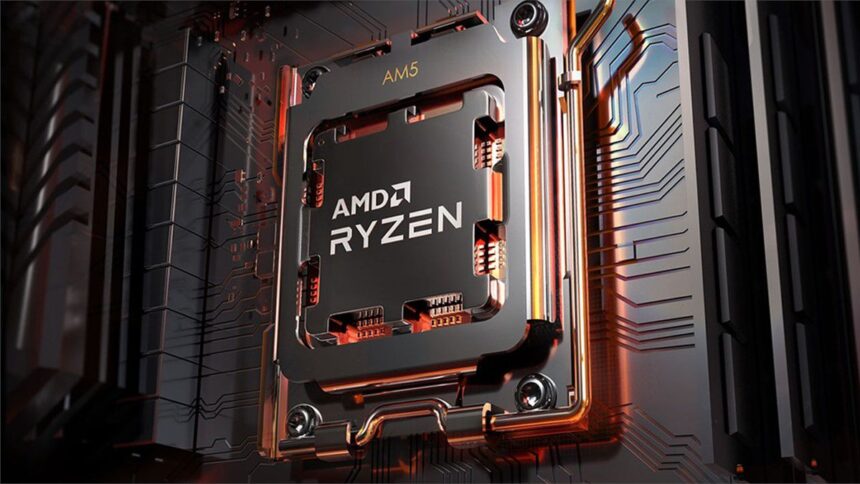
Zen 4 introduced AMD’s new AM5 platform after five years of support for AM4.
Key upgrades included:
- 5nm manufacturing process
- DDR5 memory support
- PCIe 5.0 compatibility
- Integrated RDNA 2 graphics
- AVX-512 instruction support
Although IPC improvements were smaller than previous generations at around 13%, Zen 4 delivered better efficiency, higher clock speeds, and continued support for 3D V-Cache processors.
The architecture also powers Ryzen 8000G APUs, which offer some of the strongest integrated graphics available on desktop processors.
Zen 5 (Ryzen 9000)
Launched in 2024, Zen 5 builds on AMD’s previous success with refinements across nearly every part of the processor.
Highlights include:
- 4nm and 3nm manufacturing processes, depending on the chip
- Improved branch prediction
- Better instruction parallelism
- Around 16% IPC improvement over Zen 4
- Second-generation 3D V-Cache technology
- Higher boost clocks and improved thermal performance
Zen 5 also powers AMD’s Ryzen AI 300 laptop processors, combining Zen 5 and Zen 5c cores with dedicated AI acceleration.
Key Technologies Behind AMD Zen
Chiplet Design
One of AMD’s biggest innovations is its chiplet-based processor design.
Instead of manufacturing one large processor die, AMD combines multiple smaller chips into a single package.
This approach offers several advantages:
- Lower manufacturing costs
- Improved yields
- Easier scalability
- Higher core counts
- Better energy efficiency
Intel later adopted a similar strategy with technologies such as Foveros.
Infinity Fabric
Chiplet processors require extremely fast communication between individual dies.
AMD developed Infinity Fabric to handle this communication efficiently, allowing processor cores, memory controllers, and cache to exchange data with minimal latency.
Memory speed also influences Infinity Fabric performance, making RAM selection especially important on earlier Ryzen generations.
Precision Boost Overdrive (PBO)
Precision Boost Overdrive automatically increases processor clock speeds when thermal and power conditions allow.
Rather than relying on manual overclocking, PBO dynamically adjusts CPU performance to maximize speed while remaining within safe operating limits.
Simultaneous Multithreading (SMT)
SMT allows each physical CPU core to process two instruction threads simultaneously.
This improves performance in workloads that benefit from multiple threads, including:
- Video editing
- 3D rendering
- Software development
- Modern games
- Streaming
3D V-Cache
AMD’s 3D V-Cache technology stacks additional L3 cache directly on top of the processor die.
The increased cache significantly improves gaming performance by reducing memory latency and allowing the CPU to access frequently used data more efficiently.
Processors such as the Ryzen 7 7800X3D and Ryzen 9 9950X3D have become some of the fastest gaming CPUs available thanks to this technology.
AMD Zen vs Intel
The introduction of Zen dramatically shifted the balance between AMD and Intel.
Higher Core Counts
AMD pushed mainstream desktop processors beyond four cores years before Intel caught up.
This gave Ryzen a major advantage in productivity workloads and multitasking.
Better Power Efficiency
Every Zen generation has improved performance per watt, resulting in cooler and more efficient processors than many competing Intel chips.
Longer Platform Support
AMD has built a reputation for supporting CPU sockets for several years.
The AM4 platform remained supported for roughly five years, while AMD has already committed to long-term support for AM5.
Intel, by comparison, has historically introduced new sockets more frequently, often requiring users to replace their motherboards during upgrades.
Gaming Performance
Although Intel traditionally dominated gaming benchmarks, AMD gradually closed the gap through higher IPC improvements and technologies like 3D V-Cache.
Today, Ryzen X3D processors are widely regarded as some of the best CPUs for gaming, consistently leading performance charts across modern titles.
Why AMD Zen Changed the CPU Industry
The launch of Zen transformed AMD from an underdog into one of the industry’s leading processor manufacturers.
By introducing higher core counts, improved efficiency, innovative chiplet designs, and groundbreaking technologies like 3D V-Cache, AMD forced Intel to accelerate its own development roadmap.
That increased competition has benefited consumers through faster innovation, better performance, and more competitive pricing.
With Zen 5 now powering AMD’s latest desktop and mobile processors, attention is already turning toward the next generation. While AMD has yet to officially unveil Zen 6, expectations are high that it will continue building on one of the most influential CPU architectures of the past decade.