
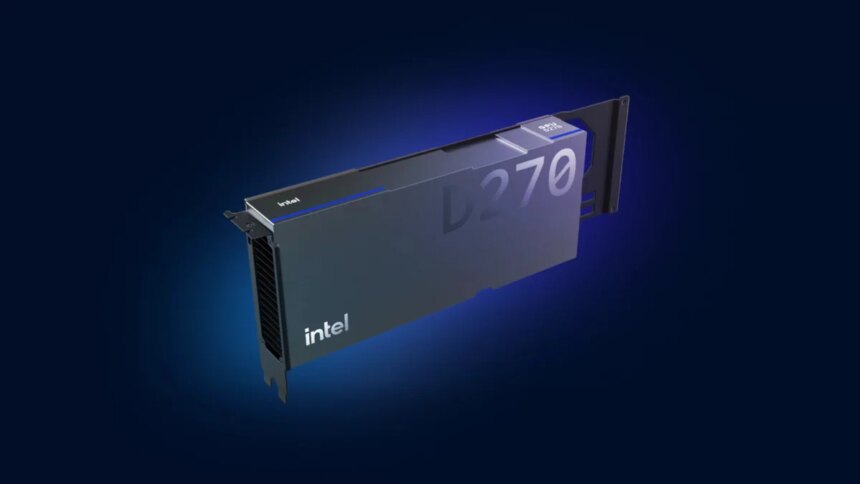
Intel has unveiled its D270 data center GPU, previously known by the codename Crescent Island, targeting artificial intelligence inference workloads with up to 480GB of LPDDR5X memory.
Built on Intel’s Xe3P graphics architecture, the accelerator is designed to run AI models rather than handle conventional graphics workloads such as gaming or 3D rendering. Its large memory capacity and focus on inference reflect Intel’s effort to compete in a data centre market dominated by specialised AI hardware from NVIDIA and AMD.
One of the key differences is Intel’s decision to use LPDDR5X memory instead of high-bandwidth memory (HBM), commonly found in competing AI accelerators. The choice could help the company manage costs and avoid some of the supply constraints associated with HBM, although the final pricing will determine whether that advantage reaches customers.
Intel D270 Specifications and Performance
The D270 combines dedicated AI processing hardware with a large memory pool intended to support demanding inference workloads.
Its reported specifications include:
- Architecture: Intel Xe3P
- Processing cores: 32 Xe3P cores
- AI acceleration: 256 XMX engines
- Memory capacity: Up to 480GB LPDDR5X
- Memory bandwidth: Up to 1.5TB/s
- Unified L2 cache: 32MB
- Peak FP8 performance: Up to 1.3 petaflops
- Power consumption: 350W
- Interface: PCIe 5.0 x16
- Cooling: Passive air cooling
The accelerator’s reported peak performance of 1.3 petaflops in FP8 precision is intended for AI calculations that can benefit from lower-precision numerical formats. Actual performance will depend on the workload, software support and operating conditions.
The 480GB memory capacity could be particularly useful for running large models that require substantial space for model weights, intermediate data and other inference operations. It may also help businesses run more demanding AI applications without splitting workloads across as many accelerators.
LPDDR5X Could Help Intel Control Costs
Intel’s decision to use LPDDR5X instead of HBM sets the D270 apart from many competing data center accelerators.
HBM offers significantly higher memory bandwidth and is widely used in hardware designed for demanding AI workloads. However, its production and packaging requirements can make it expensive and difficult to source in large quantities.
LPDDR5X is commonly associated with power-efficient systems and offers a different balance of capacity, bandwidth and cost. By adopting it for the D270, Intel could potentially provide a large amount of memory at a lower overall system cost.
The trade-off is bandwidth. The D270’s reported 1.5TB/s figure is substantial, but bandwidth-sensitive workloads may benefit more from accelerators equipped with HBM. Whether the Intel design performs competitively will depend on how effectively its processing hardware uses the available memory bandwidth.
The final price has not been announced, so any cost advantage over competing products remains unconfirmed.
A 350W Design for Data Center Inference
The D270 has a reported power rating of 350W and uses passive air cooling rather than requiring a dedicated liquid-cooling system.
That approach could simplify deployment in existing server environments, particularly for operators seeking to add AI inference capacity without making major changes to their cooling infrastructure.
The PCIe 5.0 x16 interface also allows the accelerator to connect through a widely used server expansion standard. However, system compatibility, rack-level power requirements and cooling capacity will still need to be considered during deployment.
Intel has reportedly begun testing the card with enterprise customers. The company has not yet disclosed official pricing or a general availability date.
Intel Targets the Growing Inference Market
The D270’s emphasis on inference reflects a shift in demand as businesses move beyond training AI models and begin deploying them in everyday applications.
Inference hardware runs trained models to generate responses, analyze information and complete tasks. These workloads can include chatbots, enterprise assistants and agentic AI systems that perform multiple operations with limited human intervention.
For such applications, memory capacity can be as important as raw computing performance. Larger memory pools can accommodate bigger models or more concurrent workloads, while the required balance between capacity and bandwidth varies by application.
Intel appears to be targeting customers who prioritize memory capacity, power efficiency and deployment costs. Its success will depend on real-world performance, software compatibility and pricing compared with established alternatives from NVIDIA and AMD.
No New Consumer GPUs Announced
Intel’s announcement did not include new graphics products for the consumer market.
However, a partner manufacturer reportedly indicated that Intel is preparing additional Raptor Lake processors for early 2027. The information points to a possible refresh of the company’s existing desktop processor lineup, although further details about models, specifications and launch dates have not been confirmed.
For now, the D270 is the more substantial development. Intel is positioning the accelerator as a dedicated option for AI inference, with its large LPDDR5X memory capacity and relatively modest power rating forming the core of its pitch. Whether that combination can challenge established data center products will become clearer once independent testing, pricing and availability details emerge.
Source: Intel