

Microsoft has introduced a significant upgrade to its graphics development toolkit with the release of DirectX Agility SDK version 1.619. The update officially brings Shader Execution Reordering (SER) to DirectX Raytracing (DXR) 1.2, a feature designed to improve ray tracing efficiency and boost gaming performance.
SER had previously been available in preview following its announcement at Game Developers Conference 2025, but the new release marks its full integration into the DirectX ecosystem.
Tackling Ray Tracing’s Biggest Bottleneck
Ray tracing creates realistic lighting by simulating how rays of light interact with objects in a scene. While visually impressive, the technique places heavy demands on graphics hardware.
A major source of inefficiency comes from “divergence,” a scenario where rays travel unpredictably across a scene. When this happens, a GPU must process rays sequentially rather than simultaneously, reducing performance.
SER addresses the problem by reorganizing shader workloads so that rays with similar paths are grouped together. This allows the GPU to process them in parallel, improving hardware utilization and overall rendering speed.
Significant Frame Rate Improvements
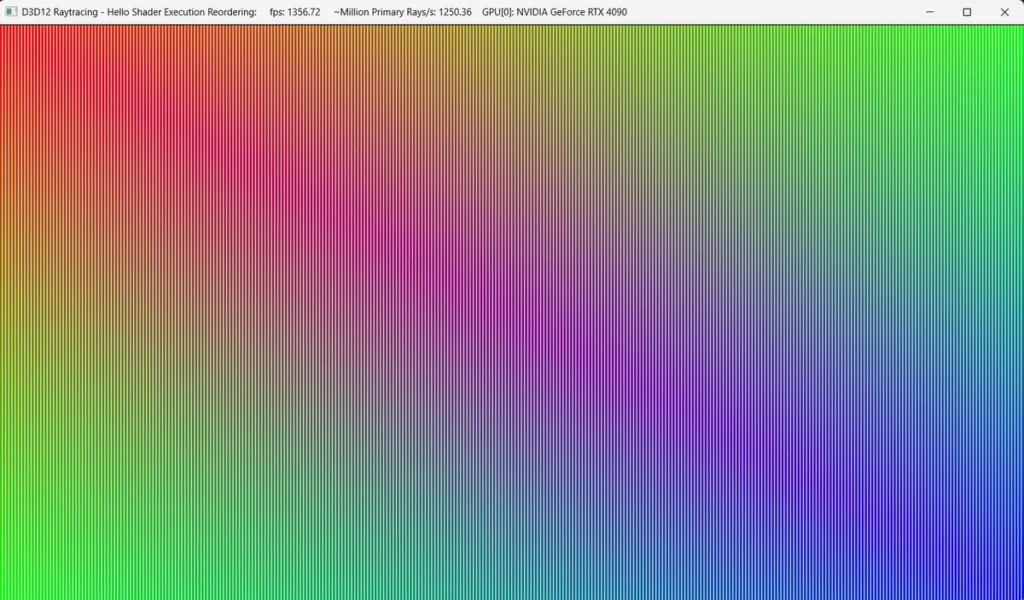
Microsoft reports substantial gains in early testing. In internal demonstrations using a NVIDIA GeForce RTX 4090, enabling SER increased frame rates by around 40 percent compared with the same workload without the feature.
In some configurations using Intel Arc B-Series graphics cards, Microsoft observed improvements of up to 90 percent.
The company has released a D3D12 ray tracing demo on GitHub that allows developers to test the technology on their own systems.
Building on Technology First Introduced by NVIDIA
SER was initially revealed by NVIDIA alongside the RTX 40-series graphics cards in 2022. By incorporating a standardized version into DirectX, Microsoft is making the technology easier for developers to adopt across a wider range of hardware platforms.
The feature is already used in modern game engines such as Unreal Engine 5, where it contributes to more efficient path tracing and real-time lighting.
SER also complements another ray tracing optimization called Opacity Micromaps (OMMs). This technology allows GPUs to skip unnecessary shading calculations when rays hit partially transparent objects, further reducing rendering workloads.
Together, the technologies help GPUs deliver more advanced lighting effects without the steep performance penalties that have historically accompanied ray tracing.
By bringing SER into the official DirectX toolkit, Microsoft aims to make advanced rendering techniques more practical for developers and gamers alike.
The update signals ongoing efforts to improve the efficiency of modern graphics pipelines, potentially enabling more widespread adoption of real-time ray tracing and path tracing in upcoming PC games.