
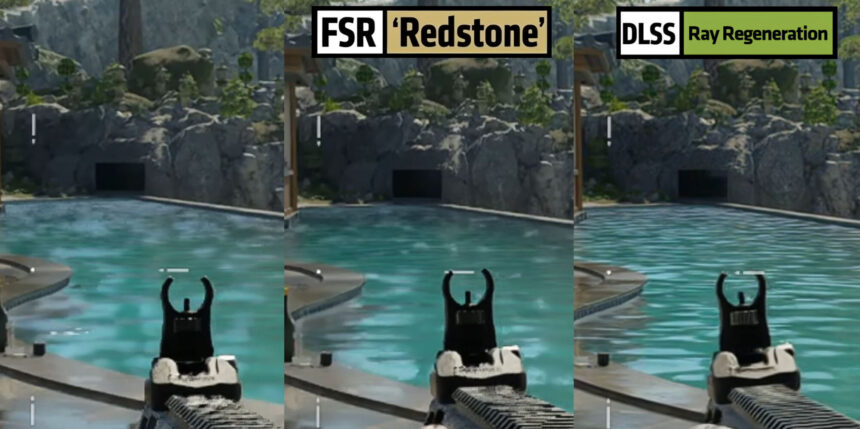
Microsoft and AMD are expanding their long-standing collaboration in PC and console gaming, unveiling new advancements designed to enhance visual fidelity and performance across modern titles. The latest development comes alongside AMD’s release of a new FSR Redstone driver, a suite of machine-learning tools designed to enhance frame rates and ray tracing capabilities on PC.
In a video update released Wednesday, Matt Booty, Microsoft’s president of game content and studios, highlighted the companies’ joint effort to develop a new technology called Ray Regeneration. According to Booty, the feature delivers a significant leap in real-time ray tracing performance.
Booty noted that Call of Duty: Black Ops 7 is the first game to integrate Ray Regeneration, and now also supports FSR Frame Generation for players using AMD’s latest Radeon 9000-series GPUs. “We’ve been working very closely with AMD to co-develop FSR Ray Regeneration to achieve a material improvement in real-time ray tracing,” he said. Booty added that FSR Redstone is just one of the advancements emerging from the partnership and hinted at further innovations to come, including those tied to future Xbox hardware.
The strengthened collaboration aligns with remarks made earlier this year by Xbox president Sarah Bond, who confirmed a multi-year agreement between Microsoft and AMD to co-engineer the next generation of Xbox consoles. While specific hardware details remain undisclosed, Bond emphasised that upcoming systems will maintain support for the full library of Xbox Series X|S titles.
Ray tracing has become a defining feature of high-end game visuals, enabling more realistic lighting, shadows, and reflections. However, the technique is notoriously demanding on hardware. Technologies such as Ray Regeneration and FSR Redstone aim to bridge that gap, enabling developers to achieve richer visual effects without compromising performance.
As both companies continue to push forward with machine-learning-driven rendering techniques, players and developers alike can expect broader adoption of advanced lighting technologies across future PC releases and the next generation of Xbox platforms.