

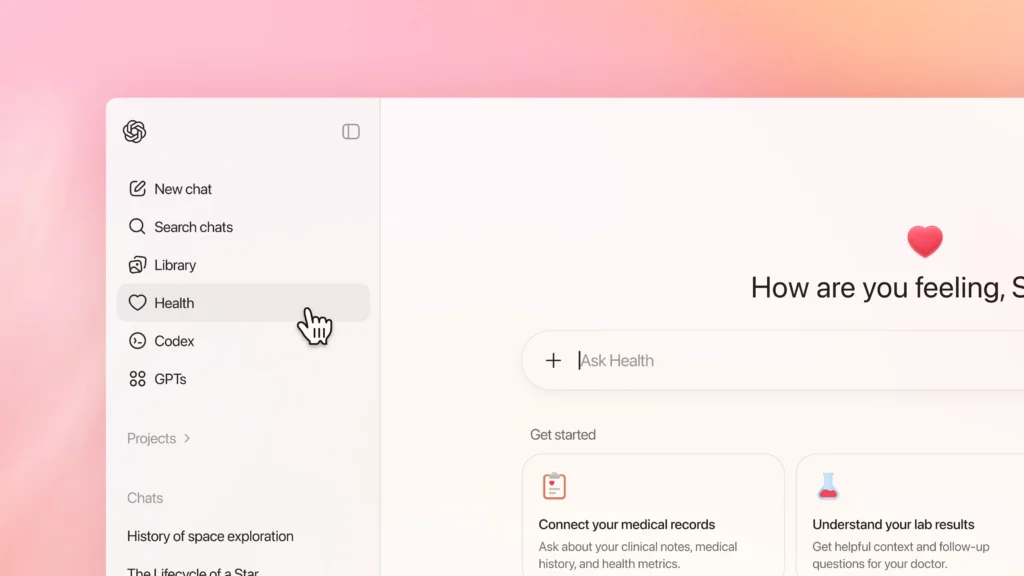
OpenAI has introduced ChatGPT Health, a new specialized experience within ChatGPT focused on health and wellness. The feature is designed to provide personalised guidance by allowing users to securely connect their own medical records and wellness applications.
According to OpenAI, ChatGPT Health can summarise recent lab results, help users prepare for clinician visits, track health trends over time, build customised diet and workout plans, and even assist with evaluating insurance options based on individual health patterns. The company said health-related questions already represent one of the most common uses of ChatGPT, with more than 230 million people worldwide seeking health and wellness information each week, based on analysis of de-identified conversations.
Limited beta rollout with regional restrictions
Access to ChatGPT Health is beginning through a limited beta program. Eligible users on Free, Go, Plus, and Pro plans can request access, provided they are located outside the European Economic Area, Switzerland, and the United Kingdom. OpenAI plans to expand availability to all users on the web and iOS platforms in the coming weeks.
At launch, medical record connections and certain app integrations are limited to the United States. Syncing with Apple Health requires an iOS device, reflecting current platform constraints.
Supported health and wellness integrations
ChatGPT Health supports connections with a range of popular services, including Apple Health, Function, MyFitnessPal, Weight Watchers—including GLP-1 meal guidance—Peloton, Instacart, and AllTrails. These integrations are intended to give users a consolidated view of their health data within a single interface.
Privacy safeguards and data separation
OpenAI emphasized that ChatGPT Health operates in a separate compartment within ChatGPT, maintaining its own memory system that does not merge with regular chats. The company stated that conversations in Health are not used to train its foundational AI models and are protected with purpose-built encryption and isolation, in addition to standard encryption during data transmission and storage.
For U.S.-based provider connectivity, OpenAI is working with b.well, allowing users to retain full control and revoke access to their data at any time.
Built with clinical input
OpenAI stated that the Health experience was developed with input from over 260 physicians across 60 countries, incorporating more than 600,000 rounds of expert feedback. The system was evaluated using OpenAI’s HealthBench framework, which assesses health-related AI behaviour and reliability.
Board member Fidji Simo shared an example of using uploaded medical records to identify a potentially dangerous antibiotic interaction, describing ChatGPT Health as a “second set of eyes” for patients navigating fragmented medical information. Meanwhile, Function has begun promoting its ChatGPT integration as a new way for members to access and understand their health data.
With ChatGPT Health, OpenAI is signalling a deeper move into regulated, high-stakes domains, positioning AI as a personalised assistant not just for information, but for ongoing health and wellness decision-making.