
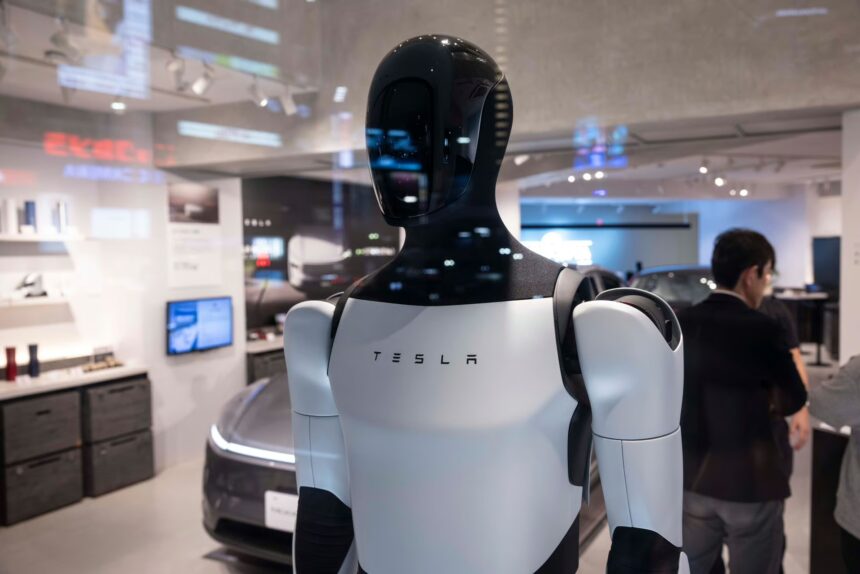
Elon Musk wants Tesla to begin selling its Optimus humanoid robots to the general public by the end of 2027, as the company reportedly increases production and works through manufacturing and software challenges.
According to a report by The Information, Tesla raised Optimus production at its Fremont, California, factory from a few dozen units per week in the second quarter of 2026 to several hundred per week in August. The reported increase suggests progress toward mass production, although Tesla has not officially confirmed the latest figures or announced a firm public launch date.
For Tesla, the challenge extends beyond building more robots. The company must also demonstrate that Optimus can perform useful tasks consistently, operate safely and justify its cost in commercial and residential settings.
Tesla Expands Optimus Production Ahead of 2027 Goal
Tesla is reportedly working toward an automated production line capable of manufacturing more than 1,000 Optimus robots per week by the end of 2026. The longer-term ambition is to reach approximately 20,000 units weekly, according to reporting by The Information, cited by Electrek.
These figures remain targets rather than confirmed production capabilities. Tesla’s January 2026 investor update also outlined plans for an initial Optimus production line, with manufacturing expected to begin before the end of the year and eventual annual capacity of one million robots.
The proposed capacity would represent a substantial expansion from the output reported in August. However, manufacturing capacity and actual production are distinct measures, and achieving the company’s long-term goal will depend on equipment, suppliers, quality control, and assembly efficiency.
During Tesla’s January earnings call, Musk discussed plans to convert the Model S and Model X production space at Fremont into a facility dedicated to Optimus manufacturing. He also acknowledged that increasing output would take time because the robot requires an entirely new supply chain.
The company has not confirmed that the proposed conversion or production targets have been completed.
Complex Hands and Assembly Issues Pose Challenges
One of the reported obstacles is the design and manufacture of Optimus’ hands. According to The Information, the V3 model includes more than 100 screws and other small components across its hands and forearms that still required manual assembly as of September.
Tesla has also reportedly faced difficulties aligning precision components during automated manufacturing, while some suppliers have struggled to maintain consistent quality as production increases.
These problems could complicate efforts to scale up output. Humanoid robots require numerous compact mechanical components to work together, particularly when performing tasks that involve handling objects, using tools or manipulating items of different shapes and sizes.
A robot that works during a controlled demonstration may still struggle to maintain consistent performance across repeated tasks. Manufacturing defects, component tolerances and maintenance requirements can become more significant as production volumes grow.
Tesla will need to address these issues before Optimus can be deployed widely outside controlled testing environments.
Software Remains a Major Hurdle
Manufacturing is only part of the challenge. Optimus must also become capable of carrying out unfamiliar tasks without extensive training or continuous human supervision.
According to the September reporting, the robots struggled with tasks they had not been specifically trained to perform. That limitation could restrict their usefulness in workplaces where conditions change throughout the day.
Many of the robots produced during the period covered by the report were reportedly being used for internal testing, training and data collection rather than routine commercial operations. Robots working inside Tesla facilities were generally assigned specific tasks in closely supervised environments.
Tesla’s longer-term ambition is to develop a more general-purpose machine capable of handling a broader range of physical work. Achieving that goal would require improvements in perception, movement, object handling and the ability to respond appropriately to unexpected situations.
The difference between a robot completing a carefully prepared demonstration and one reliably performing work throughout a normal shift will be critical to its commercial prospects.
Commercial Leasing Could Come Before Public Sales
Tesla’s plans for business customers may progress separately from its proposed public launch.
September reports indicated that the company was considering leasing Optimus robots to selected commercial customers before offering them for outright purchase. Tesla has not publicly confirmed the start date for such a program or identified the businesses that would participate.
An initial leasing strategy could allow the company to monitor robot performance in real working environments, collect operational data and make improvements before expanding distribution.
Factories and warehouses may be suitable early testing grounds because many tasks take place in established environments with relatively predictable workflows. Tesla could also use these deployments to evaluate maintenance needs, reliability and the amount of human oversight required.
However, a leasing program would not necessarily mean Optimus was ready for widespread use. Early deployments could remain limited to selected customers and specific tasks.
What Optimus Could Mean for Businesses
For companies considering humanoid robots, Tesla’s proposed timeline raises questions about practical performance, costs and integration with existing operations.
Businesses will need to assess whether Optimus can perform tasks reliably over extended periods, how much training it requires, how frequently it needs maintenance and whether it can work safely alongside people.
Integration will also matter. A robot must fit into established production processes and deliver measurable benefits compared with human workers or conventional automation equipment.
Tesla has not announced final public pricing, purchase terms or a confirmed retail release date for Optimus. Without those details and reliable performance data, businesses cannot yet make a complete assessment of the technology’s commercial value.
Musk’s late-2027 target remains an ambition rather than a guaranteed launch date. Tesla’s reported production growth is a sign of progress, but the company’s ability to solve manufacturing and software problems will determine whether that progress translates into a commercially viable product.