
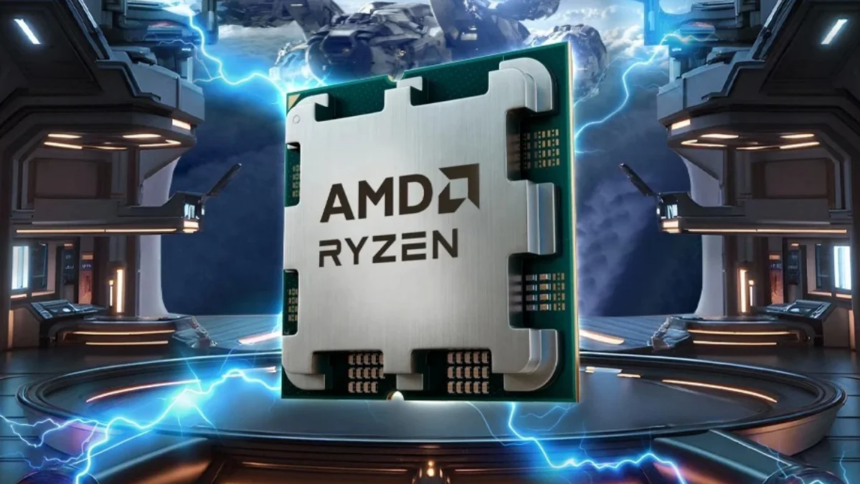
AMD may be preparing one of the biggest changes to its Ryzen processor lineup in years. The upcoming Zen 6 architecture is expected to increase the number of cores per Core Complex Die (CCD), potentially allowing future consumer Ryzen processors to reach 24 cores and 48 threads.
For years, AMD’s mainstream Ryzen 9 desktop processors have topped out at 16 cores. Zen 6 could finally break that ceiling, although the company has not officially confirmed a 24-core consumer model. The possibility is based on information and architectural details discussed by AMD, as well as speculation about how the new chiplet design could be used.
If these expectations prove accurate, the change could deliver a substantial improvement in heavily threaded workloads and give AMD more room to compete with Intel’s upcoming high-end desktop processors.
Zen 6 could increase CCD capacity to 12 cores
The biggest architectural change reportedly involves the design of AMD’s chiplets. With Zen 4 and Zen 5, each standard CCD contains a maximum of eight CPU cores. Zen 6 is expected to increase that capacity to 12 cores per CCD.
That would make a dual-CCD configuration capable of supporting up to 24 cores and 48 threads, potentially bringing this configuration to mainstream Ryzen desktop processors.
<text>AMD has not confirmed that it will release a 24-core consumer Ryzen model, so this remains a possible configuration rather than an announced product.</text>
Increasing core density could also have benefits beyond simply adding more processing units. Keeping more cores within a single CCD may help reduce communication between separate chiplets during workloads that rely heavily on parallel processing.
The cache design is another important part of the expected changes. A larger CCD could provide a unified L3 cache shared across its 12 cores, potentially improving the efficiency of data exchange among those cores. However, the actual latency and performance benefits will depend on the final architecture and implementation.
A potentially significant leap in multithreaded performance
Moving from 16 to 24 cores would represent a 50% increase in core count compared with AMD’s current 16-core consumer configuration.
That does not automatically translate into a 50% performance improvement. Results will depend on clock speeds, instructions per clock (IPC), memory performance, power limits, and how effectively applications use additional cores.
Nevertheless, workloads such as video rendering, 3D production, software compilation, and other heavily multithreaded tasks could benefit considerably from the extra processing capacity.
Zen 6 is also expected to take advantage of a more advanced manufacturing process, with 2nm technology frequently discussed in connection with the architecture. A smaller process could help AMD improve transistor density and power efficiency, although final specifications and manufacturing details should be treated as unconfirmed until officially announced.
The combination of higher core density, architectural improvements, and more efficient manufacturing could make Zen 6 a particularly important generation for desktop processors.
AMD could face stronger competition from Intel
The potential arrival of 24-core Ryzen processors would also have implications for the competition with Intel.
Intel has already offered processors with 24 cores in its high-end consumer lineup, using a hybrid architecture that combines performance and efficiency cores. Meanwhile, rumors surrounding its upcoming Nova Lake generation suggest that Intel may push core counts even further.
AMD could therefore benefit from increasing the number of full-performance cores available in its consumer processors, particularly for users who prioritize sustained multithreaded workloads.
However, core counts alone will not determine which manufacturer comes out ahead. Architecture, power consumption, gaming performance, pricing, and platform costs will all play important roles.
Zen 6 could mark a new chapter for Ryzen
A move to 12 cores per CCD would give AMD considerably more flexibility in designing its next-generation Ryzen processors. A dual-chiplet configuration with 24 cores and 48 threads is an appealing possibility, especially for users who need more processing power without moving to an expensive workstation platform.
For now, AMD has not officially confirmed a 24-core consumer Ryzen processor or provided the complete specifications of its Zen 6 desktop lineup. The expected improvements should therefore be viewed as informed speculation rather than guaranteed product features.
Still, if AMD delivers on the architectural changes being discussed, Zen 6 could represent a major step forward for Ryzen and intensify competition in the high-performance desktop CPU market.