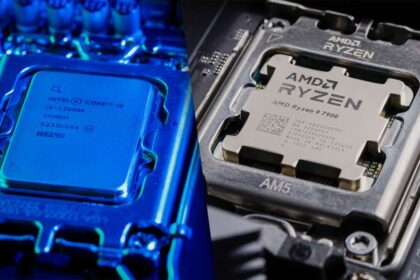

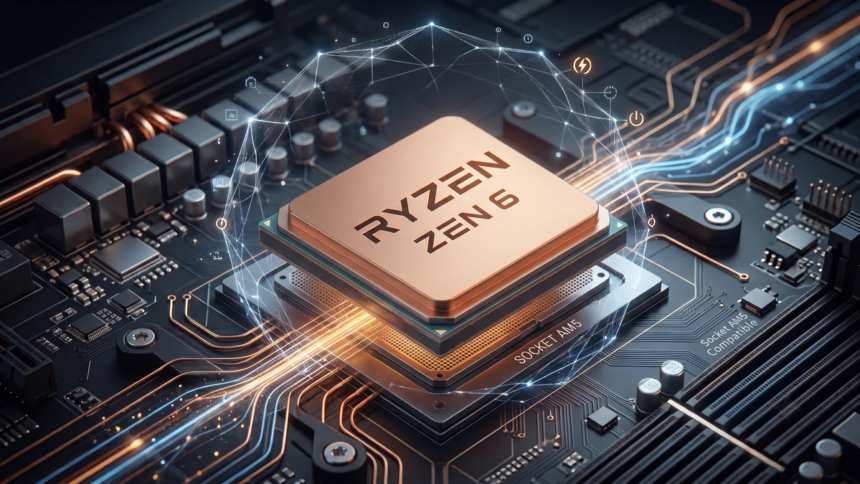
AMD is preparing another major step in its CPU roadmap with Zen 6, an architecture that could significantly raise the performance ceiling of future Ryzen processors. The company has initially introduced the design through its EPYC server lineup, but the technology developed for data centers is expected to influence the next generation of consumer chips as well.
Although AMD has yet to announce the specifications of its Zen 6-based Ryzen processors, current information points to higher core counts, larger caches, faster clock speeds and improved power efficiency. The rumored consumer platform, reportedly known as Olympic Ridge, could strengthen AMD’s position against Intel in both desktop and notebook markets.
Up to 24 cores and 48 threads
The most significant change could come from the number of cores AMD places on each compute chiplet.
From Zen 3 through Zen 5, AMD used up to eight cores per CCD. Zen 6 increases that figure to 12 cores per CCD. A high-end Ryzen processor with two CCDs could therefore reach 24 cores and 48 threads.
AMD is also expected to retain simultaneous multithreading, allowing each core to handle two threads. That could give future Ryzen chips a strong advantage in heavily threaded workloads, including video production, 3D rendering, software development and other professional applications.
The higher core density would also allow AMD to increase performance without depending entirely on the combination of performance and efficiency cores used by Intel in many recent processors.
Ryzen could move beyond 6 GHz
Clock speeds could receive another significant boost with Zen 6.
Improvements in AMD’s architecture and manufacturing process are expected to push the highest-end Ryzen processors beyond 6 GHz at stock settings. Some reports have even suggested that selected configurations could approach or exceed 7 GHz under favorable thermal conditions.
Those figures remain speculative until AMD releases official specifications. Still, higher peak frequencies would benefit games and applications that continue to rely heavily on single-core performance.
A larger cache could benefit gamers
AMD also appears ready to increase the amount of cache available to Zen 6 processors.
The standard L3 cache per CCD could rise from 32 MB to 48 MB. A processor using two CCDs would consequently have up to 96 MB of L3 cache.
The potential gains become even more interesting for future X3D models. AMD’s 3D V-Cache technology could reportedly increase its stacked cache capacity from 64 MB to 96 MB per die.
Combining the standard L3 cache with the additional 3D V-Cache could push a future Ryzen X3D processor beyond 144 MB of total L3 cache. More cache can reduce the need to access slower system memory, which can be particularly useful in gaming workloads.
Zen 6 LP could improve notebook battery life
AMD may also introduce a new low-power core design alongside its conventional Zen 6 and Zen 6C architectures.
Known in current reports as Zen 6 LP, the design would focus on background processes, idle workloads and other tasks that do not require the performance of AMD’s main CPU cores.
The approach could allow notebooks and handheld gaming devices to move lightweight background activity to extremely efficient cores. That would reduce unnecessary power consumption and potentially extend battery life, particularly during standby and low-intensity use.
If AMD delivers the expected efficiency improvements, Zen 6 LP could help its mobile processors compete more closely with ARM-based platforms in low-power scenarios.
AMD’s long-term support for its CPU platforms could remain another advantage with Zen 6.
The next-generation Ryzen processors are expected to maintain compatibility with the AM5 ecosystem. If the current reports prove accurate, owners of compatible 600- and 800-series motherboards could upgrade to a Zen 6 processor without replacing their motherboard or memory.
That would continue AMD’s strategy of supporting a socket across multiple generations, similar to what the company achieved with AM4.
The approach contrasts with Intel’s historical tendency to introduce new sockets more frequently, although Intel has recently shown signs of extending platform support.
AMD has yet to reveal consumer Zen 6
AMD has already brought Zen 6 technology to its EPYC server processors, but the company has not formally unveiled its next Ryzen generation.
That means specifications such as 24 cores, 48 threads, 6 GHz-plus clock speeds, expanded cache and Zen 6 LP remain expectations rather than confirmed Ryzen features.
For now, AMD’s server roadmap provides the clearest indication of where its consumer processors could be heading. With Zen 7 and Zen 8 already part of the company’s longer-term plans, the arrival of Zen 6 could become another important step in AMD’s effort to maintain pressure on Intel across desktop, notebook and workstation markets.