
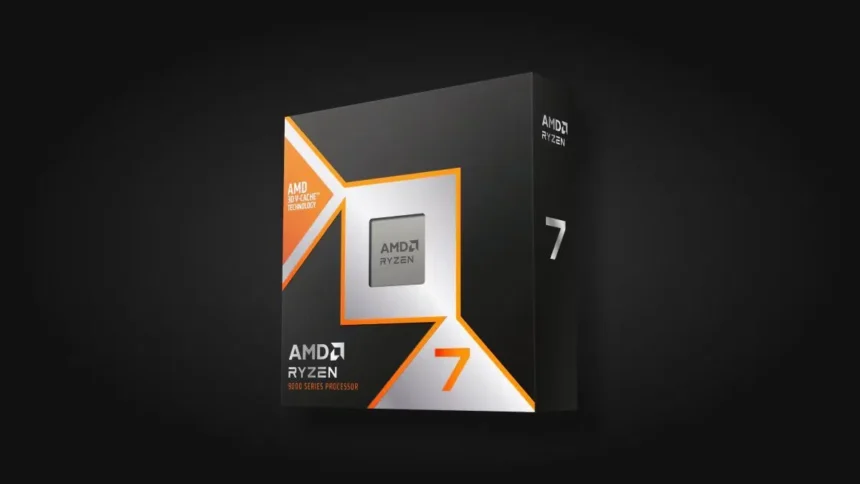
An early benchmark entry has provided the first numerical look at AMD’s unreleased Ryzen 7 9850X3D, giving enthusiasts a preliminary idea of how the upcoming processor may compare to the highly regarded Ryzen 7 9800X3D, currently one of AMD’s strongest gaming CPUs.
The data comes from a newly posted PassMark result that surfaced this week and was shared on X. According to the listing, the Ryzen 7 9850X3D achieved a CPU Mark score of 41,840 based on a single submitted system. For context, the Ryzen 7 9800X3D averages 39,962 points in the same benchmark, placing the unreleased chip roughly 5% ahead in overall multi-threaded performance.
Single-Thread Gains Align With Higher Boost Clocks
PassMark’s breakdown also highlights a modest but consistent uplift in single-threaded performance. The Ryzen 7 9850X3D recorded a single-thread score of 4,632, compared with about 4,425 for the 9800X3D—again landing close to a 5% improvement.
While PassMark applies a wide margin of error to early results drawn from a single system, the numbers align closely with what is already known—or strongly rumored—about the chip’s specifications. Previous shipping leaks and a briefly visible AMD product page have suggested that the 9850X3D will feature:
- 8 cores / 16 threads
- Zen 5 architecture
- 96 MB of L3 cache (3D V-Cache)
- 120 W TDP
- Up to 5.6 GHz boost clock
That boost frequency represents a clear bump over the 9800X3D’s 5.2 GHz maximum, and the PassMark single-thread uplift is broadly consistent with the performance increase expected from a clock speed jump of that magnitude, assuming no major architectural differences.
Memory Performance Shows Minimal Change
According to leakers referencing the PassMark subtests, the Ryzen 7 9850X3D posted a Memory Mark score of 4,421, compared to a baseline of around 4,390 for the 9800X3D. This approximately 1% difference suggests that memory behavior remains effectively unchanged.
That result fits expectations. There have been no indications of changes to the memory controller, cache topology, or platform configuration between the two processors. Both are anticipated to share a similar AM5 ecosystem, reinforcing the idea that the 9850X3D is an incremental refinement rather than a structural redesign.
How the 9850X3D Fits in AMD’s X3D Stack
Seen in the context of AMD’s recent X3D lineup, the early numbers suggest a more modest generational gain compared to the previous upgrade cycle:
| CPU | Architecture | L3 Cache | Max Boost | PassMark CPU Mark |
|---|---|---|---|---|
| Ryzen 9 9900X3D | Zen 5 | 128 MB | 5.5 GHz | 56,307 |
| Ryzen 7 9850X3D | Zen 5 | 96 MB | 5.6 GHz | 41,840 |
| Ryzen 7 9800X3D | Zen 5 | 96 MB | 5.2 GHz | 39,962 |
| Ryzen 7 7800X3D | Zen 4 | 96 MB | 5.0 GHz | 34,296 |
The leap from the 7800X3D (Zen 4) to the 9800X3D (Zen 5) delivered a far more dramatic improvement. PassMark scores for that upgrade showed roughly 17% higher multi-threaded performance and around 18% better single-threaded performance, driven by Zen 5’s architectural updates and higher operating frequencies.
By comparison, the 9850X3D appears to be a tuning-focused refresh, emphasizing clock speed increases rather than sweeping architectural gains.
Gaming and Desktop Performance
The Ryzen 7 9800X3D has held the crown in many gaming performance charts since launch, thanks to its large L3 cache and strong Zen 5 IPC. Based on this first benchmark glimpse, the 9850X3D is likely to retain that leadership position, albeit with a smaller margin than the generational jump it replaced.
For gamers, this suggests continuity rather than disruption: excellent performance, slightly higher frame rates in CPU-limited titles, and a refinement of an already proven formula. For AMD, it reinforces the company’s strategy of using X3D chips to maintain dominance at the high end of gaming workloads while keeping power envelopes relatively stable.
Early Data, Not a Final Verdict
It’s essential to emphasise that a single PassMark result is far from definitive. Synthetic benchmarks provide a useful reference point, but they don’t fully capture real-world performance, especially in gaming and productivity workloads that favor large cache designs like X3D.
More clarity will come once retail samples are available and independent testing expands across multiple systems. Still, this PassMark listing provides the first concrete performance marker for the Ryzen 7 9850X3D and a helpful indication of how AMD’s next X3D refresh may slot into its existing desktop lineup ahead of the company’s next expected product cycle.