
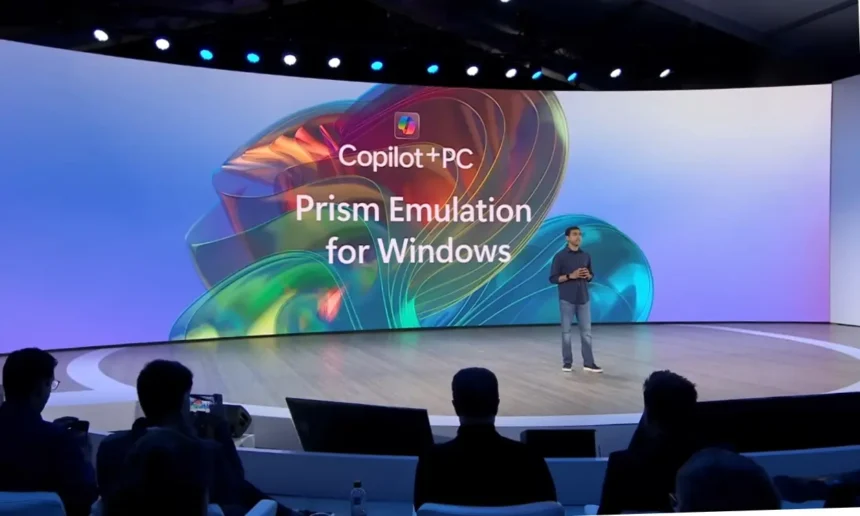
Microsoft has released a significant update to its Prism emulator, further improving x86 application support on Windows 11 devices powered by Arm-based processors. The latest enhancement broadens compatibility to include applications and games that rely on advanced x86 instruction sets such as AVX and AVX2-features previously unsupported on Windows on Arm systems.
According to Microsoft, the update delivers both improved performance and wider software compatibility for devices running Snapdragon X-series chips and other ARM processors.
“With today’s update, Prism expands its capability by supporting translation of more x86 instruction set architecture extensions, including AVX and AVX2, as well as related extensions BMI, FMA, F16C, and others,” the company said. This advancement enables demanding applications like Ableton Live 12 to operate smoothly under emulation.
The upgraded Prism emulator is being deployed now through the latest Windows 11 releases, including versions 24H2 and 25H2. The improvements activate automatically for 64-bit applications, while 32-bit executables can be manually enabled to use the new features.
Windows on Arm has progressed dramatically since its 2017 debut, when limited hardware capabilities and sparse developer support left the platform struggling to gain traction. Today, the ecosystem has matured, with a growing lineup of Arm-powered PCs and widespread adoption of native app support. Prism, introduced as a successor to the original Windows 10 emulation layer, represents a major leap in performance and compatibility.
Most x86 applications now run seamlessly on modern Snapdragon-powered devices, and many users report little to no distinction between using an Arm machine and a traditional Intel-based PC. With this latest update, Microsoft continues its push to close the compatibility gap and strengthen Windows on Arm as a competitive platform across consumer and professional workloads.
- Is Windows On ARM Worth It
- Windows on ARM’s Prism Emulator Expands x64 App Support and Instruction Sets
- Compatible Apps for Windows ARM