
For years, the idea of carrying a full PC in your pocket has hovered between ambition and gimmick. From early convergence experiments like Motorola Atrix, Microsoft Continuum, and Samsung DeX, the industry has repeatedly tried—and often failed—to make smartphones function as real computers.
In 2026, however, the combination of mature ARM hardware and increasingly capable desktop modes may finally make that vision practical. That is the bet behind the NexPhone.
Developed by Nex Computer, the NexPhone is an Android smartphone designed to operate not only as a phone, but also as a Linux workstation and even a Windows 11 machine when connected to external hardware. Rather than chasing nostalgia for Windows Phone, the project focuses on flexibility: one device, multiple operating systems, and a clear emphasis on productivity.
Android First, Desktop When Needed
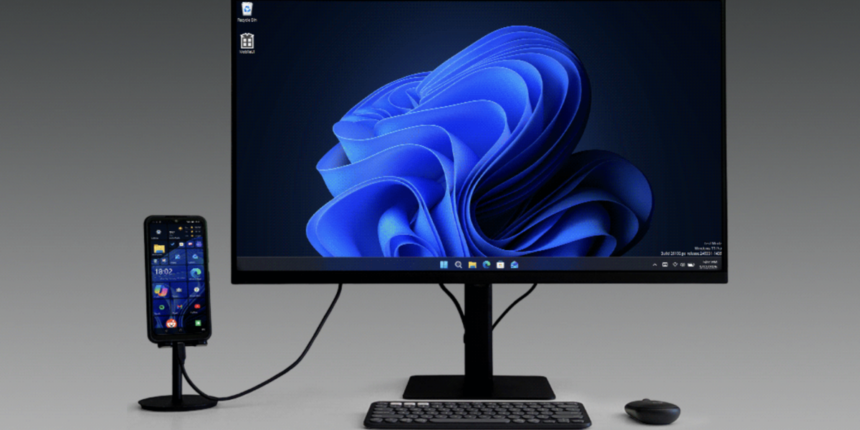
At its core, the NexPhone is a mid-range Android handset. When plugged into a monitor, keyboard, and mouse, it switches into a desktop-style Android experience with resizable windows and multitasking. This approach aligns closely with improvements arriving in Android 16, where Google has been investing heavily in external display support and productivity features.
The goal is not to replace a laptop outright, but to make Android feel less like a mobile-only platform when used on a larger screen.

Linux as an App
One of NexPhone’s most distinctive features is its built-in Linux environment, which runs as an Android application. This allows users to access a full Linux terminal and tools without rebooting the device. While hardly aimed at casual users, the feature is clearly targeted at developers, system administrators, and power users who want command-line access and development utilities on the go.
It is a deliberately “geek-friendly” addition—useful, powerful, and unapologetically niche.
Windows 11 via Dual Boot
Where the NexPhone truly breaks from conventional smartphones is its support for Windows 11 through a dual-boot setup. Instead of trying to turn Windows into a phone interface, Nex treats it strictly as a desktop OS. When booted into Windows, the NexPhone effectively becomes an ARM-based PC.
This design choice is partly a response to Microsoft discontinuing Windows Subsystem for Android, which dashed hopes of seamless Android app support in Windows. Nex’s solution cleanly separates roles: Android for mobile use, Windows for desktop-style workloads.
The Chip That Makes It Possible
The entire concept hinges on the Qualcomm QCM6490, an industrial and IoT-focused processor rather than a flagship smartphone chip. Qualcomm positions this SoC for multi-operating-system support, including Android, Linux, and Windows 11 IoT Enterprise. It also supports USB-C with DisplayPort output—essential for external monitors.
By prioritising compatibility over raw performance, Nex has chosen stability and flexibility as the foundation of the device.
Built as a Tool, Not a Fashion Device
The NexPhone is clearly designed as a working device rather than a lifestyle product. It features a ruggedised body certified to MIL-STD-810H standards, along with IP68 and IP69 resistance ratings. A 5,000 mAh battery, wireless charging, and a 64MP rear camera round out the hardware.
Nex expects the device to launch in the third quarter of 2026 with an estimated price of $549. Reservations will require a refundable $199 deposit.
A Niche Idea With Real Potential
The NexPhone is unlikely to appeal to mainstream smartphone buyers. But for users who want access to Android, Linux, and Windows in a single pocket-sized device, it represents a rare and thoughtful attempt at convergence.
Rather than reviving Windows Phone, Nex is offering something more pragmatic: a phone that can genuinely become a computer when needed.
Whether this vision finds a sustainable audience remains to be seen—but in 2026, it no longer feels like science fiction.