
AMD’s long-awaited FSR Redstone upgrade has finally landed, and early tests show noticeable jumps in both image quality and performance. This major update refreshes AMD’s entire upscaling and frame-generation ecosystem, adding machine-learning-driven frame generation along with two new rendering tools-Ray Regeneration and Radiance Caching-to improve ray-traced visuals.
With these additions, AMD is now much closer to matching Nvidia’s latest DLSS features, particularly in terms of frame generation. The only major omission is multi-frame generation, which Nvidia still offers.
FSR Redstone rolls out today, providing developers with immediate access and allowing players to try the new technology in the hundreds of games that already support earlier versions of FSR. To use the full suite, you’ll need the latest AMD drivers, possibly updated game patches, and an RDNA 4 graphics card. Once installed, most players should be able to activate the features without much difficulty.
What is FSR Redstone?
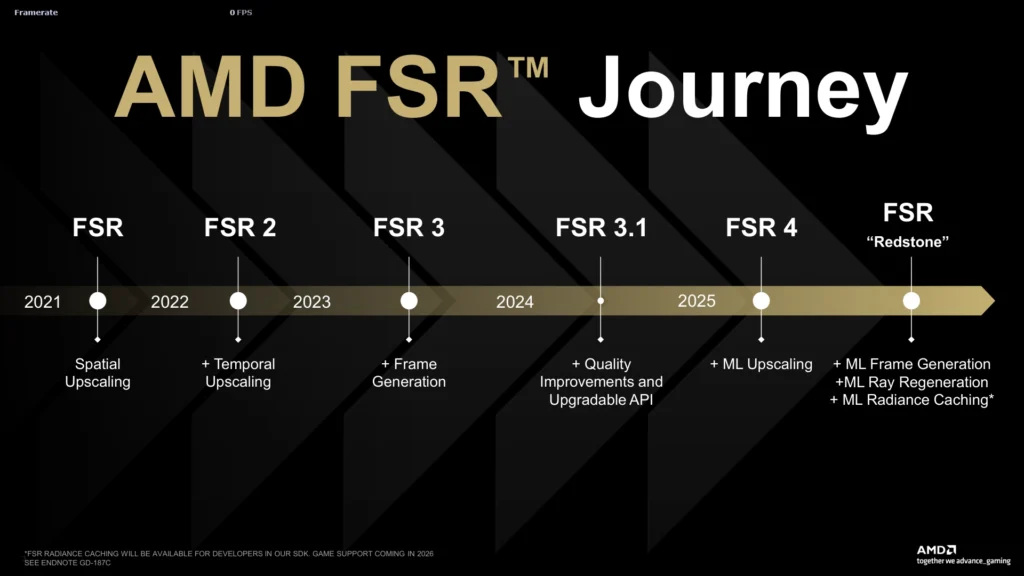
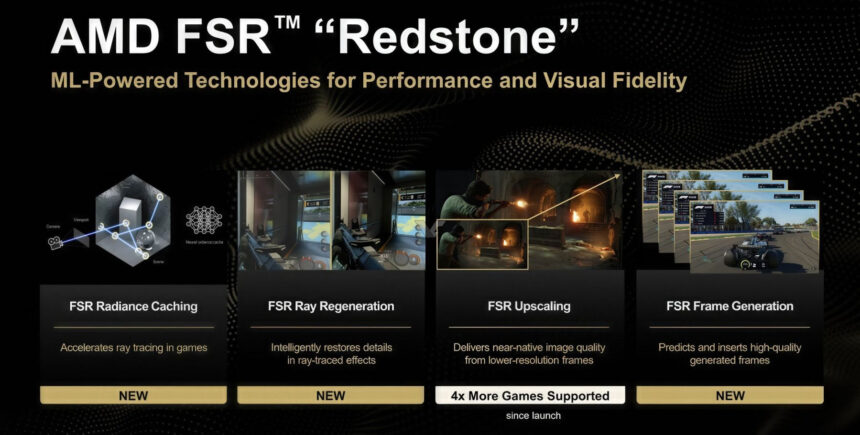
FSR Redstone is AMD’s new unified FidelityFX toolset, replacing several older components with a streamlined lineup. The foundation of the suite is FSR Upscaling, which replaces FSR 4 and serves as AMD’s main spatial upscaler-similar in role to Nvidia’s DLSS Super Resolution.
Another major pillar is FSR Frame Generation, which now uses machine learning for the first time. This shift dramatically raises image quality compared to earlier FSR frame-gen methods and brings AMD much closer to Nvidia’s latest DLSS Frame Generation approach.
Redstone also debuts two entirely new technologies:
- FSR Ray Regeneration – A machine-learning-based denoising system aimed at cleaner, more stable ray-traced reflections. This is AMD’s counterpart to Nvidia’s Ray Reconstruction.
- FSR Radiance Caching – Designed to lighten the workload for ray-traced lighting by using machine learning to estimate complex lighting with far fewer calculations, similar to Nvidia’s Neural Radiance Cache.
How to Access FSR Redstone
To use the full set of Redstone features, you’ll need a Radeon RX 9000-series GPU such as the RX 9070 XT, RX 9070, or RX 9060 XT. Older cards still support past FSR versions, but Redstone’s machine-learning enhancements rely on the AI cores found only in RDNA 4.
Once you install the newest driver and open the AMD Software app, you can enable Redstone features either directly in supported games or through AMD Software. Some titles will let you toggle the new tools in their graphics menus, while others require you to activate them from the Gaming → Graphics section in AMD Software. These settings can override in-game FSR options for titles that support at least FSR 3.1-again, only when running on an RX 9000 GPU.
FSR Redstone Frame Generation
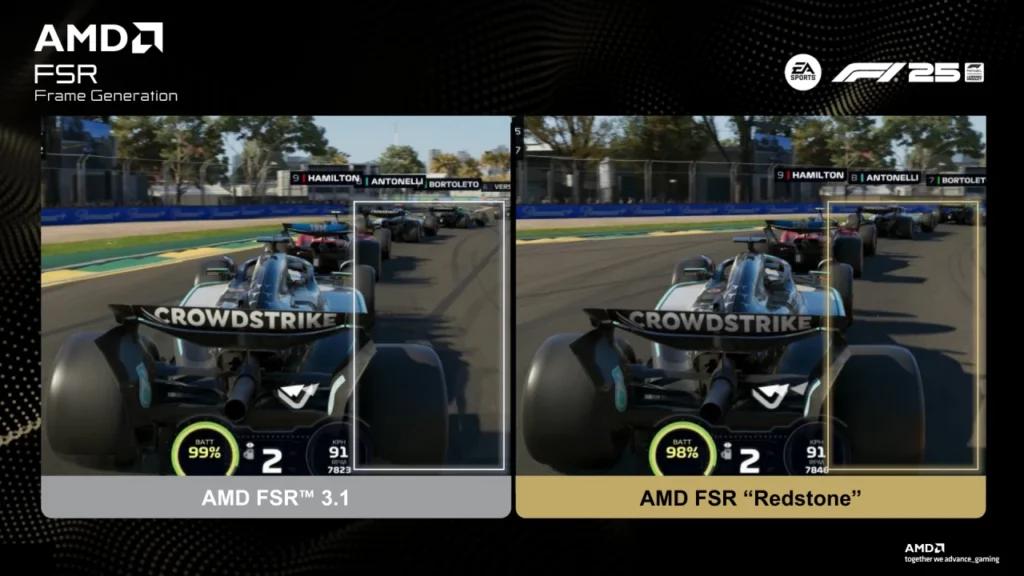
The most anticipated part of Redstone is its revamped frame generation. AMD has replaced its previous heuristic approach with a machine-learning model that works similarly to Nvidia’s DLSS frame-gen pipeline.
The system takes the two most recent game frames, along with motion vectors and a depth map, then feeds them into a pair of ML models plus a supplemental non-AI algorithm. The output is a synthetic frame that blends smoothly with the native rendering stream.
Image quality is noticeably better than AMD’s older frame-generation tech and sits much closer to Nvidia’s results. Performance gains are comparable to earlier FSR frame-gen implementations, but the visual improvements are far more pronounced. The only drawback is that AMD still doesn’t include multi-frame generation.
FSR Upscaling
FSR Upscaling is simply the renamed FSR 4 algorithm. Although this component hasn’t changed under Redstone, FSR 4 already represented a huge leap for AMD. It closes the gap significantly with Nvidia’s image-upscaling quality, even though Nvidia has since shifted to a transformer-based model. In everyday use, both companies’ upscalers now deliver strong results.
FSR Ray Regeneration
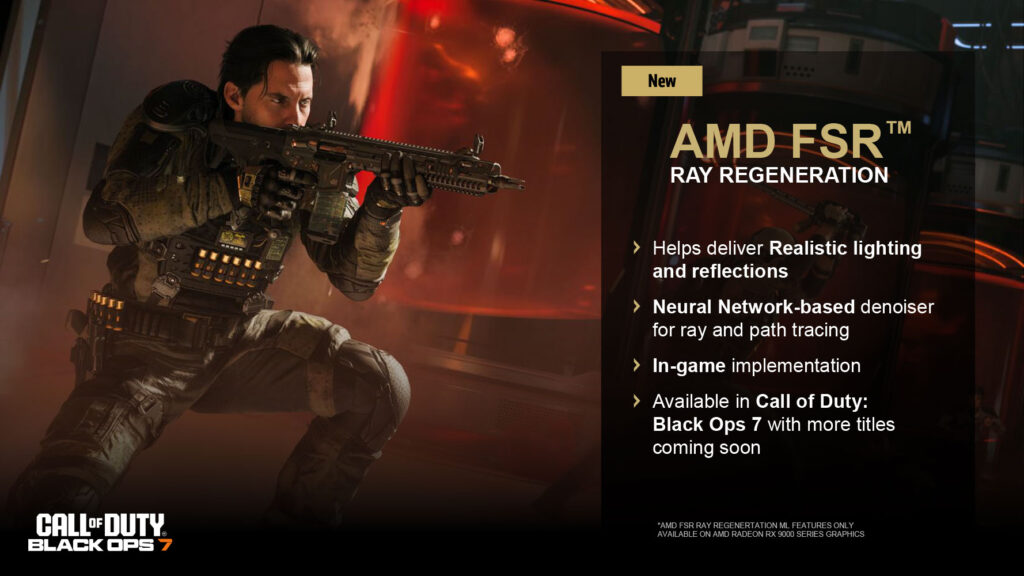
Ray Regeneration is Redstone’s first new ray-tracing feature and aims to clean up noisy ray-traced reflections. Traditional ray tracing often samples too few rays to match the detail of the rendered scene, resulting in noisy or grainy reflections. Standard denoisers help, but they often lead to soft or unstable results, especially in reflective surfaces.
Ray Regeneration improves on this by feeding additional scene information-normals, depth, diffuse and specular lighting, radiance, and visibility-into a machine-learning model that guides the denoising process. The result is far clearer reflections and much more stable detail when the camera moves. The improvement over conventional ray tracing is dramatic.
This feature is available only on RDNA 4 GPUs and must be enabled by developers. So far, Call of Duty: Black Ops 7 is the first title to support it.
FSR Radiance Caching
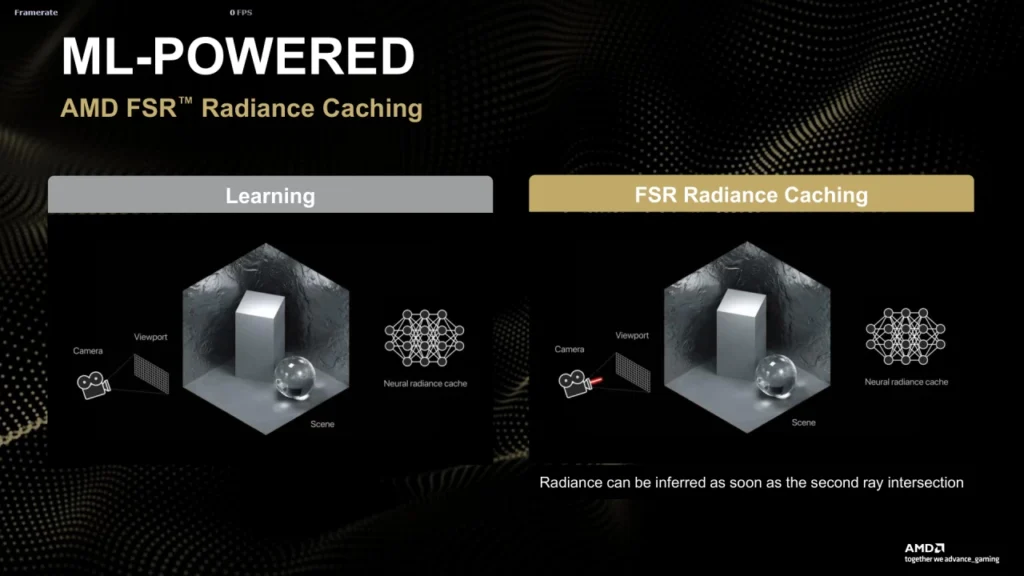
Radiance Caching is the final component in the Redstone lineup, though it’s not yet available in shipping games. The goal is to reduce the enormous computational load of path-traced lighting. Instead of calculating every bounce of every light ray at runtime-which can involve countless interactions-Radiance Caching precomputes the scene’s lighting and feeds this into an AI model.
In real-time, the engine then needs only a couple of surface interactions to approximate complex lighting. AMD hasn’t given specific performance numbers yet, but the potential gain could be substantial. Game support is expected to begin in 2026.
- Microsoft and AMD Deepen Gaming Tech Partnership With Launch of Ray Regeneration
- What is AMD Smart Access Memory
- Early PassMark Listing Offers First Performance Glimpse of AMD’s Ryzen 7 9850X3D