
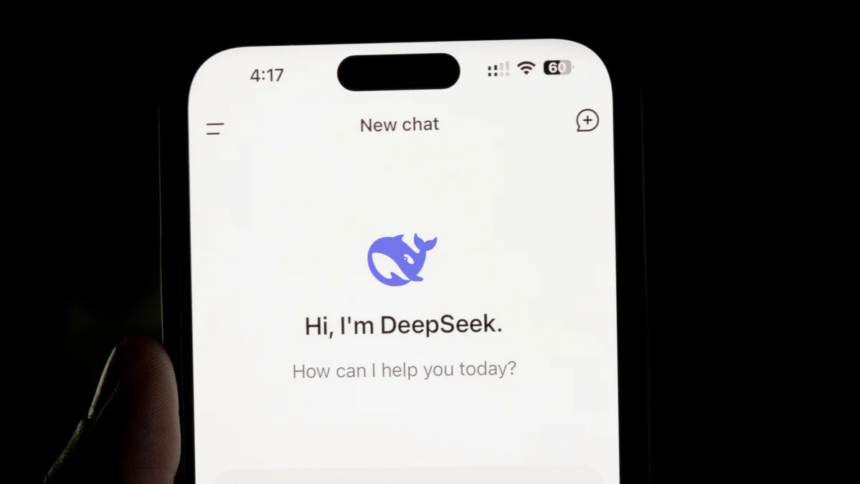
Chinese artificial intelligence company DeepSeek has reduced the usage price of its V4-Flash AI model by 50% and abandoned plans to introduce dynamic pricing that would have increased costs during periods of high demand.
The latest price reduction strengthens DeepSeek’s strategy of competing on affordability, following its emergence earlier in 2025 as a major challenger in the AI market by demonstrating that advanced models could be developed without the massive infrastructure budgets typically associated with leading U.S. companies.
V4-Flash Among the Lowest-Cost AI Models
According to independent testing by Artificial Analysis, the V4-Flash model costs an average of $0.03 to complete a standard benchmark task.
That makes it significantly less expensive than several leading AI models. Anthropic’s Claude Fable 5 costs approximately $3.15 per benchmark task, while OpenAI’s GPT-5.6 Sol averages around $1.86, based on the same evaluation.
DeepSeek charges $0.14 per million input tokens and $0.28 per million output tokens for V4-Flash. The model contains 284 billion parameters and serves as a streamlined version of the V4 family introduced earlier this year.
Lower Cost Does Not Mean Higher Performance
Despite its aggressive pricing, V4-Flash does not lead performance rankings.
Artificial Analysis awarded the model 50 points on its Intelligence Index, matching Google’s Gemini 3.6 Flash. More advanced models from OpenAI and Anthropic score at least nine points higher.
Among Chinese AI developers, Moonshot AI’s Kimi K3 currently leads the benchmark with 57 points, highlighting the growing competition within China’s AI industry.
Alongside its pricing strategy, DeepSeek is investing in autonomous AI agents.
According to a report by the South China Morning Post, the company is inviting open-source developers to test a new agent execution platform called Harness, which is currently in beta.
The project is led by Cui Tianyi, co-founder of Hong Kong investment firm TSY Capital and a former Jane Street engineer who joined DeepSeek in March. Earlier this year, Cui said the development team remained smaller than the company ultimately intends.
Harness is designed to connect large language models with execution environments, allowing AI systems to write and run code across multiple stages while using external tools without constant human supervision. Interest in this type of technology has grown rapidly following the success of Anthropic’s Claude Code, as companies increasingly compete not only on model performance but also on the capabilities of their AI development platforms.
Investment Plans Continue
DeepSeek is also pursuing expansion through new financing.
According to BigGo Finance, the company is negotiating a funding round that could value the business at approximately $70 billion. It is also preparing for a potential stock market listing on mainland China later this year.
Neither the fundraising nor the initial public offering has been officially confirmed by the company.
DeepSeek’s latest price reduction adds momentum to an increasingly competitive AI market in China.
Chinese authorities have previously warned technology companies about what they describe as excessive price competition, arguing that aggressive discounting can undermine long-term industry development without creating proportional value.
Despite those concerns, government support for computing infrastructure and energy continues to help AI companies operate with relatively thin profit margins.
The pricing pressure is also expected to affect international competitors. Cloud providers and AI partners, including companies working with OpenAI, may face increasing pressure to lower inference costs as more affordable alternatives enter the market.
For chipmakers such as Nvidia, the impact is less direct. More efficient AI models reduce computing requirements for individual tasks, although lower prices could increase overall demand for AI services and offset some of those efficiency gains.