


Training large artificial intelligence models has become increasingly difficult as systems grow in size and complexity, with rising costs, heavy power consumption, and frequent training failures posing major challenges for developers. A new research paper from DeepSeek outlines a technique designed to address one of the most costly problems in modern AI development: instability during training.
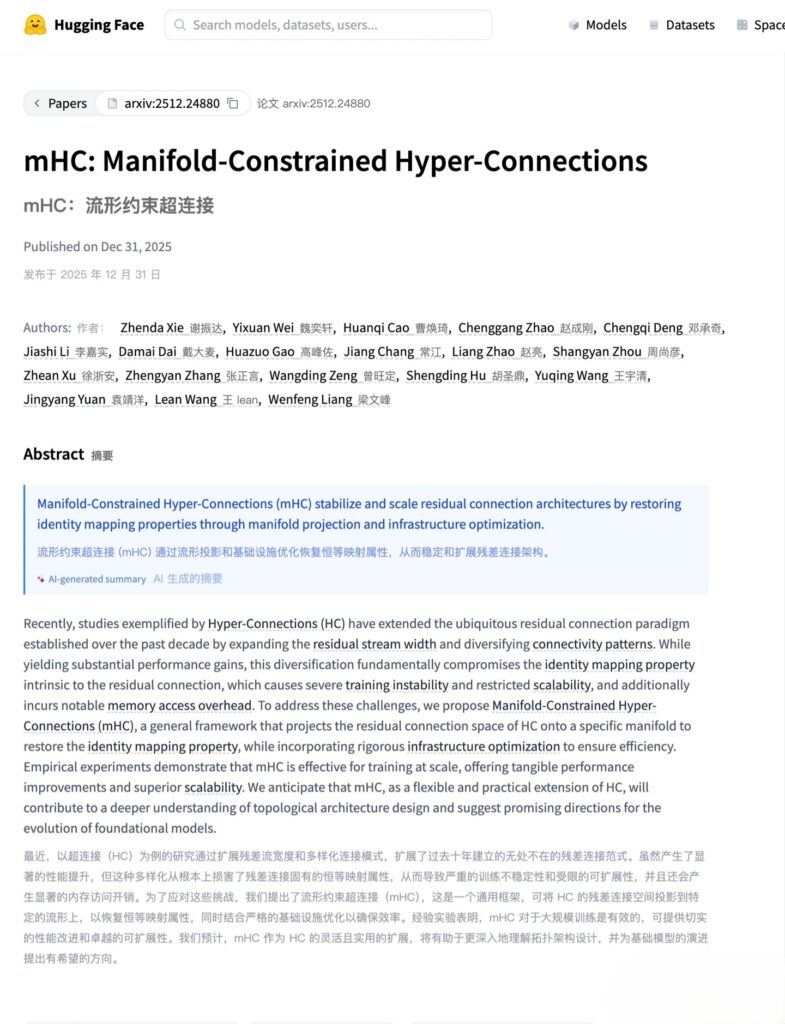
The proposed method, known as manifold-constrained hyperconnection (mHC), is designed to enhance reliability rather than maximise raw performance. According to the research, many large-scale AI models fail partway through training due to numerical instability or unpredictable behaviour.
When these failures occur, entire training runs must be restarted, wasting weeks of work, large amounts of electricity, and extensive GPU resources.
DeepSeek’s approach focuses on keeping model behaviour within more predictable boundaries as training progresses. By reducing the likelihood of sudden breakdowns, the method helps ensure that training jobs can be completed successfully, rather than being abandoned midway.
While the technique does not directly reduce the power usage of graphics processors, it addresses energy consumption in a different way—by limiting waste. Stable training means fewer restarts, fewer redundant calculations, and less time spent rerunning failed experiments. Over large training cycles, these savings can significantly reduce overall energy use.
The research also highlights potential gains in efficiency at scale. More stable models reduce the need for brute-force solutions, such as adding extra hardware or extending training schedules simply to overcome instability. This can lower the total compute required to train large models, easing pressure on both infrastructure and energy resources.
DeepSeek researchers note that mHC is not a solution to hardware shortages or rising electricity demands on its own. Instead, it represents a practical improvement in how existing resources are used. As AI systems continue to expand, such refinements could play an important role in making large-scale model training more sustainable.
As language models continue to grow larger each year, reducing inefficiency may become as critical as improving accuracy or capability. In this context, DeepSeek’s work suggests that progress in AI may depend not only on faster hardware, but also on more reliable methods for training increasingly complex systems.