
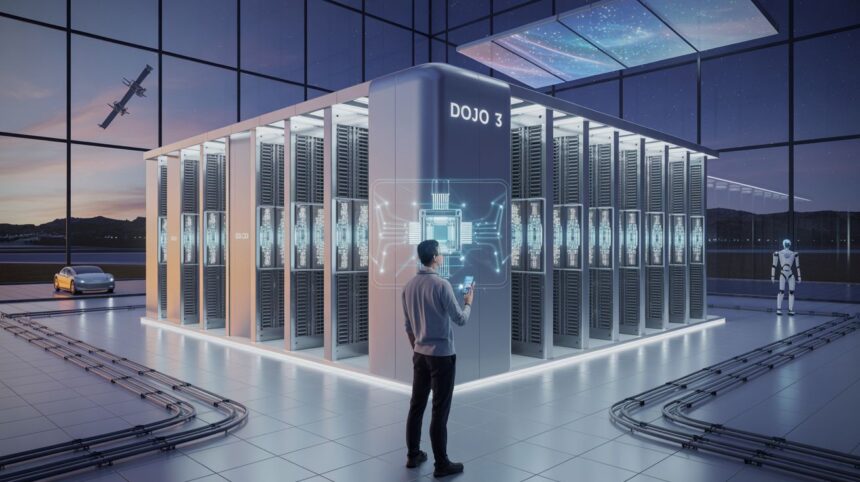
Elon Musk has confirmed that Tesla has resumed development of its Dojo 3 supercomputer, citing renewed momentum following progress on the company’s next-generation AI5 chip. In a post shared on X, Musk said the AI5 design is now in “good shape,” allowing Tesla to reallocate engineering resources back to the long-delayed Dojo project.
Musk added that Tesla is actively hiring additional engineers to support chip development, signalling a renewed internal push toward custom silicon that will power the company’s future artificial intelligence infrastructure.
Now that the AI5 chip design is in good shape, Tesla will restart work on Dojo3.
If you’re interested in working on what will be the highest volume chips in the world, send a note to [email protected] with 3 bullet points on the toughest technical problems you’ve solved.
— Elon Musk (@elonmusk) January 18, 2026
The update comes months after Tesla halted work on Dojo’s wafer-level processor initiative in late 2025, a move that raised questions about the program’s long-term future. Since its announcement, Dojo has gone through multiple redesigns, but Musk now says Dojo 3 will mark a turning point by relying entirely on Tesla-developed hardware. Earlier efforts, including Dojo 2, combined in-house chips with Nvidia-supplied accelerators.
According to Musk, Dojo 3 will be built around Tesla’s upcoming AI chip families, including AI5 and future AI6 and AI7 variants. AI5 is described as nearly ready for deployment and, by Musk’s account, delivers performance comparable to Nvidia’s Hopper architecture on a single chip, while two AI5 chips working together are said to approach Blackwell-class performance at significantly lower power consumption.
Tesla’s chip game is no joke.
AI5 chip will be roughly comparable to a Nvidia Hopper Chip in a single SoC, and Blackwell class when you run two of them together.
Those AI chips from Nvidia run ~$25K-$50K each. AI5 will run at ~250W compared to H100’s 700W or Blackwell’s… pic.twitter.com/KAWtwQQC2K
— Nic Cruz Patane (@niccruzpatane) January 19, 2026
The renewed Dojo effort aligns with Musk’s recently outlined nine-month chip release cadence, under which Tesla plans to introduce a new AI processor generation roughly every nine months. AI6 is expected to be the first chip released under this accelerated schedule, with AI7 likely serving as an incremental refinement rather than a completely new architecture.
Tesla’s previous attempts at building a competitive supercomputer have faced challenges. Dojo 1 was initially positioned as a breakthrough system but struggled to stand out amid rapid advances from Nvidia, while Dojo 2 was ultimately cancelled during development. Musk’s latest comments suggest that Dojo 3 could be the company’s most serious attempt yet to establish a viable alternative to off-the-shelf AI compute platforms.
Musk also hinted that Dojo 3 may be used for “space-based AI compute,” though he did not provide further details on how that capability would be deployed.
Whether Dojo 3 can meet Tesla’s ambitions remains uncertain, but the restart of the project underscores the company’s determination to control more of its AI stack—from silicon to supercomputing—at a time when demand for advanced AI infrastructure continues to intensify.