
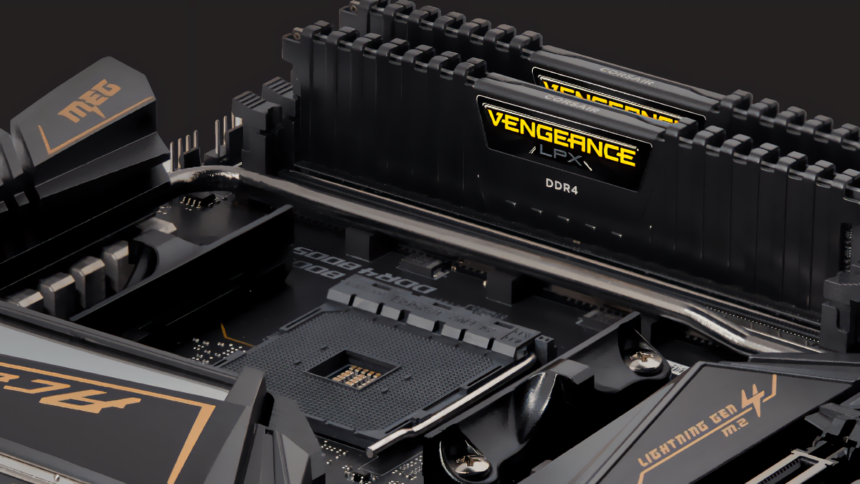
PC gamers spend a considerable amount of time debating whether 8 GB of VRAM is sufficient for modern graphics cards, especially at 1080p. But there’s another kind of memory that matters just as much in a gaming setup: system RAM. So the big question is-do you really need 16 GB of RAM for gaming?
The honest answer isn’t as straightforward as yes or no. There are too many moving parts for that. Still, after testing, we can confidently say the truth sits somewhere in between.
The sweet spot for PC gamers
Not all that long ago-less than a decade-16 GB of RAM was more than enough for just about anything. As time went on, software grew heavier, games became more complex, and expectations changed. Today, 16 GB has effectively become the baseline for gaming PCs, while 8 GB is mostly reserved for basic office machines.
Debates around 16 GB of RAM are nearly as heated as those about GPUs with 8 GB of VRAM. And yes, with 16 GB, you can run most modern games without major issues. Performance will generally be solid, assuming the rest of your system-SSD, CPU, and GPU-is up to the task.
That said, if you’ve never used more than 16 GB of RAM, you probably don’t realise what extra memory can actually do. We tested 32 GB specifically to show what changes when you double the capacity, even if 16 GB already feels “fine.”
What really eats up your RAM
One important thing to clear up: RAM isn’t used by your game alone. It also handles everything happening behind the scenes-operating system processes, background services, browsers, launchers, and any apps sitting quietly in the taskbar.
So when you look at memory usage in tools like MSI Afterburner, you’re seeing total system consumption, not just what the game itself is using.
There’s another factor that often gets overlooked: VRAM overflow. If your graphics card runs out of video memory, it starts borrowing system RAM. On a machine with only 16 GB-especially if you’re gaming on an 8 GB GPU and have background apps open-this can happen more often than you’d think.
When RAM gets tight, frame pacing suffers. You may still achieve a decent average FPS, but the lows become worse, resulting in noticeable stutters and inconsistent gameplay.
Test setup and game selection
To isolate the impact of RAM, we ran a straightforward comparison between 16 GB and 32 GB on a high-end system with no other bottlenecks. The test rig was an Alienware Aurora 2025 provided by Dell, equipped with:
- Intel Core Ultra 9 285K
- NVIDIA GeForce RTX 5070
- 1 TB PCIe 5.0 M.2 SSD
- 2×16 GB DDR5-5200 memory
We chose three different games to cover a range of scenarios:
- Hellblade 2 (graphics-heavy, linear single-player)
- Doom: The Dark Ages (fast-paced shooter)
- Elden Ring Nightreign (open-world, multiplayer-focused)
All tests were done at 1080p. Higher resolutions made little difference in RAM usage, as most of the extra load shifted to VRAM. Ray tracing, upscaling, and frame generation were disabled.
16 GB vs 32 GB: the real difference
Elden Ring Nightreign
This was the lightest title in the test, yet it still showed notable differences in minimum frame rates. With 16 GB, the frame rate dropped to 34 FPS, while with 32 GB, it increased to 45 FPS. Interestingly, the 0.1% low behaved oddly, favouring the 16 GB setup-but averages were identical at the game’s 60 FPS cap.
The main takeaway here isn’t averages; it’s consistency. The drops were sharper and more frequent on 16 GB, even if recovery was quick.
Doom: The Dark Ages
Doom scaled better with extra memory across the board. While 16 GB still delivered a smooth experience-with averages near 95 FPS-the 32 GB setup improved minimums slightly and pushed maximum frames significantly higher.
In practice, the difference isn’t night and day, but gameplay felt smoother overall on 32 GB, especially during chaotic combat moments.
Hellblade 2
Hellblade 2 heavily relied on the GPU, and this was evident in the results. The average FPS was actually slightly higher on the 16 GB setup, while the 32 GB setup achieved a higher maximum FPS. Minimums were nearly identical, making this more or less a draw.
However, the biggest gap appeared in the 0.1% lows, where 32 GB clearly provided more stability during heavy scenes.
So, is 16 GB still enough?
Yes-16 GB of RAM is still perfectly usable for gaming today. The test results confirm that you can enjoy modern games without constant frustration or poor performance.
That said, 32 GB clearly offers benefits. In our tests, memory usage regularly exceeded 16 GB when more RAM was available, indicating that the system effectively utilises the extra space to load assets and background processes more efficiently.
Looking ahead, it’s also worth noting that many new games are starting to list 32 GB as “recommended,” with 16 GB slipping into the “minimum” category. Titles like Star Wars Jedi: Survivor and Hogwarts Legacy already push RAM usage well past 20 GB on some systems.
While 16 GB still gets the job done, it may not remain comfortable forever. For now, it’s enough-but the margin is getting thinner every year.