
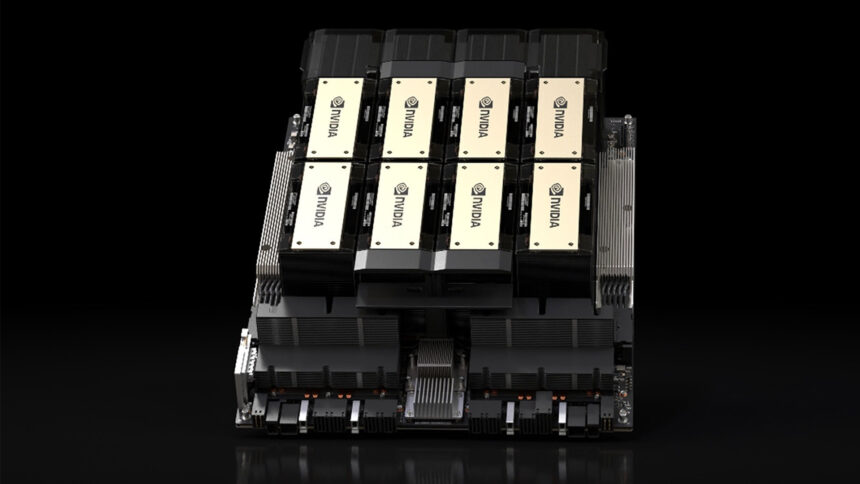
Nvidia is considering increasing the output of its H200 data-center GPUs after interest from Chinese technology firms surged beyond current supply levels, according to sources cited by Reuters. The discussions began shortly after the U.S. government adjusted export rules, allowing Nvidia to ship the H200 to China under a framework that requires a 25% tariff on sales.
Chinese customers, including Alibaba and ByteDance, have reportedly approached Nvidia in recent days with requests for large orders of the H200. Several industry sources said demand has already exceeded the limited number of units Nvidia currently produces. The company has not publicly commented on the matter.
The H200, built by TSMC on its 4nm process and paired with high-capacity HBM3e memory, is one of Nvidia’s most advanced Hopper-generation accelerators. Output remains constrained because Nvidia has been prioritising production of newer Blackwell GPUs, as well as preparing for its next-generation Rubin platform-both of which rely on the same advanced manufacturing capacity.
Even with Washington’s updated export stance, the path to actual shipments remains complex. Chinese authorities have yet to approve H200 imports and have reportedly held emergency meetings to assess the broader impact. One idea under consideration would limit the volume of Nvidia hardware any company can purchase, tying the cap to its investments in domestic accelerators-an effort to strengthen China’s homegrown AI chip ecosystem.
Still, the H200’s capabilities make it difficult for Chinese firms to overlook. It is the highest-performing Nvidia GPU currently permitted for sale in the country and offers a significant advantage over the H20, the model created specifically to meet earlier U.S. restrictions.
White Oak Capital Partners’ Nori Chiou told Reuters that the H200 delivers “approximately 2–3 times” the performance of the most advanced locally produced accelerators, widening a gap that continues to shape procurement decisions.
Nvidia’s deliberations come at a time when advanced wafer capacity at TSMC is already under intense pressure. The foundry must juggle demand not only from Nvidia but also from cloud providers building their own custom silicon.
Any move to allocate more resources to the H200 could disrupt production plans for Nvidia’s newer architectures. Analysts also note that U.S. policy shifts are not guaranteed to remain stable, and Chinese regulators could still impose limits regardless of Washington’s current position.
For now, Nvidia is assessing options, but any decision to expand H200 output will require navigating both geopolitical uncertainty and a crowded manufacturing pipeline.
- New SAFE Chips Act Seeks to Freeze AI Chip Exports to China for 30 Months
- RTX 5070 Already Among Most Popular GPUs, Surpasses RTX 4070
- U.S. Chip Curbs Push China to Double Down on Homegrown AI Hardware