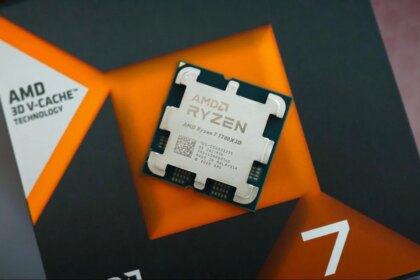

AMD’s AM4 platform refuses to fade away. Nearly a decade after its introduction alongside the first Ryzen processors, the socket continues to attract buyers, particularly as rising memory prices make newer platforms more expensive to build.
Data from German retailer Mindfactory shows just how strong the older platform remains. During July, AM4 processors accounted for 34.9% of CPU sales at the retailer, compared with a combined 9.2% for Intel’s LGA-1700 and LGA-1851 platforms.
AMD controls 90% of July CPU sales
AMD dominated Mindfactory’s processor sales in July, accounting for roughly 90% of nearly 3,000 CPUs sold.
AM5 represented 56% of sales, while AM4 accounted for another 34.9%. Intel’s two current desktop sockets made up the remaining 9.2%.
That means AMD’s older AM4 platform alone sold almost four times as many processors as Intel’s LGA-1700 and LGA-1851 platforms combined at the German retailer.
The Ryzen 7 9800X3D remained the best-selling processor, taking 20.8% of total sales. The Ryzen 5 5500 followed closely with 17.1%.
Ryzen 5000 keeps AM4 relevant
The continued popularity of Ryzen 5000 processors helps explain why consumers are still choosing AM4.
The Ryzen 7 5800X3D 10th Anniversary Edition ranked third in Mindfactory’s July sales, capturing 9.5% of the market with approximately 310 units sold.
The processor costs considerably more than the original Ryzen 7 5800X3D did at launch, but demand remains strong due to its gaming performance and large 3D V-Cache.
For users who already own an AM4 motherboard, upgrading to a Ryzen 5000 chip can also be considerably cheaper than moving to a new platform. Buyers can continue using DDR4 memory instead of purchasing the more expensive DDR5 modules required by AM5 systems.
High DDR5 prices are helping older CPUs
Memory costs have become an important factor in purchasing decisions.
The Ryzen 5 5500 currently leads processor sales on Amazon, while the relaunched Ryzen 7 5800X3D also ranks near the top.
For consumers building a complete system, however, the processor price tells only part of the story. Moving to AM5 also requires DDR5 memory, and current prices can make the overall upgrade substantially more expensive.
That has encouraged some buyers to stay with AM4 and reuse existing DDR4 memory instead of paying for a full platform upgrade.
Other older Ryzen processors are also performing well. The Ryzen 7 5700X appears twice near the top of Amazon Brazil’s processor rankings, while the Ryzen 5 5600GT also holds a strong position.
Intel struggles to gain ground
Intel’s position in the rankings highlights the strength of AMD’s older platform.
The best-selling Intel processor in the cited Amazon Brazil rankings is the Core i5-14600K, which sits only at 22nd place.
AMD’s dominance is not limited to its newest Ryzen 9000-series processors. The continued demand for Ryzen 5000 shows that buyers are increasingly considering the total cost of a platform rather than simply choosing the latest CPU generation.
As long as DDR5 prices remain high and AM4 processors continue to offer competitive gaming performance, AMD’s older socket is likely to remain relevant.
Introduced in 2017, AM4 has already enjoyed an unusually long life for a mainstream desktop platform. Current sales figures suggest that, despite the arrival of AM5 and newer CPU generations, its retirement is still far from complete.