
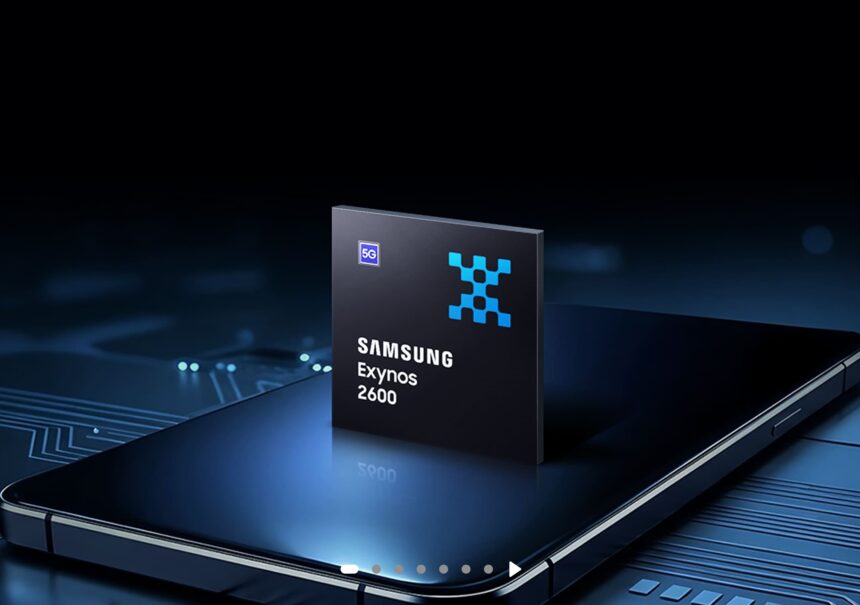
Samsung has confirmed that its upcoming Exynos 2600 chipset will use a customised version of AMD’s RDNA 4 graphics architecture, marking a major leap forward for the company’s mobile GPU performance and AI capabilities. The new graphics processor, branded Xclipse 960, is built on the world’s first 2nm GAA process and is expected to debut in Samsung’s 2026 flagship smartphones.
The customised RDNA 4 implementation used in the Exynos 2600 is internally referred to as MGFX4. It replaces the earlier MGFX3 design, based on RDNA 3, which powered the Exynos 2500. According to Samsung, the shift enables a significant performance uplift, with the Exynos 2600 delivering roughly double the overall performance of its predecessor and up to a 50% improvement in ray tracing tasks.
A key addition enabled by MGFX4 is Exynos Neural Super Sampling (ENSS), Samsung’s new AI-based upscaling technology. ENSS is designed to enhance image quality and performance in games by rendering at lower resolutions and intelligently reconstructing frames, serving a similar role to NVIDIA’s DLSS and AMD’s FSR on PCs.
On the hardware side, the Xclipse 960 GPU features eight Work Group Processors (WGPs), which are optimized compute blocks aimed at improving latency and instructions per clock. While Samsung has slightly reduced the GPU’s peak clock speed to 980MHz compared to the Exynos 2500’s 999MHz, the company says architectural improvements more than offset the frequency change.
Early benchmark data suggest that competition remains tight at the high end. In Geekbench 6 OpenCL and Vulkan tests, the Exynos 2600 trails Qualcomm’s latest flagship platform, the Snapdragon 8 Elite Gen 5, by roughly 10–20%. Despite this gap, Samsung is emphasising efficiency gains and real-world performance improvements rather than raw benchmark dominance.
Thermal management is also a major focus this generation. Samsung says it has introduced a new “Heat Pass Block” design that improves heat flow and reduces thermal resistance by 16%, a move intended to sustain performance during extended gaming or heavy workloads.
The Exynos 2600 is widely expected to power the Galaxy S26 and Galaxy S26+ when they launch in early 2026. With a more advanced GPU architecture, AI-driven upscaling, and improved ray tracing, Samsung is positioning the Exynos 2600 as its most capable mobile chipset to date-one that aims to narrow the gap with its main rivals while showcasing the benefits of AMD’s latest graphics technology on smartphones.