
Bazzite, one of the most widely used Linux distributions for gaming, has reached a new milestone with official support for the GPD Win 5 handheld. The update marks the first time the SteamOS-inspired operating system has received what its developers describe as an “official adaptation” for a device built around AMD’s Strix Halo platform.
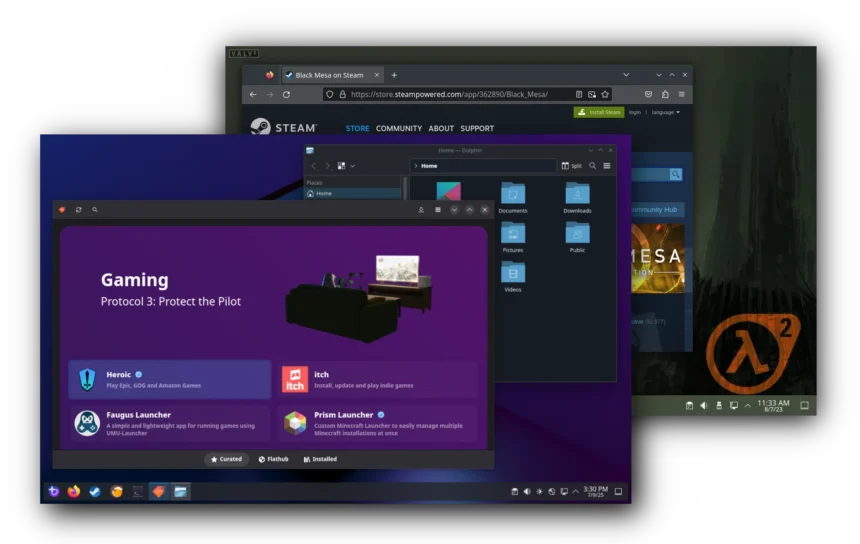
Bazzite is designed to closely mirror the console-style experience of Valve’s SteamOS, the operating system that ships with the Steam Deck and is also being adopted by Lenovo for select Legion Go models. While Bazzite has long been available as an open-source alternative for handheld PCs, this announcement signals deeper, device-specific optimisation.
Official Adaptation for GPD Win 5
The news was shared by a GPD representative on Reddit, confirming that Bazzite development is now officially aligned with GPD Win 5. Although the handheld continues to ship with Windows 11 Home by default, the Linux-based operating system will now receive targeted patches to improve compatibility and stability on the device.
Early adopters had reported issues related to Wi-Fi and audio support when running Bazzite on the Win 5. According to the GPD representative, Wi-Fi problems have already been addressed, and ongoing fixes are being coordinated through the project’s Discord server, where users can work directly with contributors from the Bazzite community.
As an open-source project, Bazzite has always been freely installable on the Win 5. The difference with this update lies in long-term maintenance: future releases will include enhancements tailored specifically to the Strix Halo hardware configuration.
Powered by AMD Strix Halo
The GPD Win 5 is built around AMD’s Ryzen AI Max family, internally known as the Strix Halo. These processors were introduced last year and are aimed at high-performance mobile systems. The Win 5 is available with either a Ryzen AI Max+ 395 or a Ryzen AI Max 385, paired with RDNA 3.5–based Radeon 8060S or 8050S graphics.
At the high end, the Ryzen AI Max+ 395 features 16 Zen 5 CPU cores, while the AI Max 385 includes 8 Zen 5 cores. Both chips integrate AMD’s XDNA 2 AI engine, capable of delivering up to 126 AI TOPS, underscoring the platform’s focus on AI-accelerated workloads alongside gaming.
A Console-Style Alternative to Windows
Bazzite ships with Steam pre-installed and emphasizes a streamlined, console-like interface similar to SteamOS. While Microsoft has taken steps toward a comparable experience in Windows through features like the Xbox Full Screen Experience, many handheld PC users continue to favour Linux-based solutions for their lighter footprint and performance advantages.
In several benchmarks, SteamOS-based systems have shown better gaming efficiency than their Windows counterparts.
The GPD Win 5 itself is positioned as a premium handheld, offering up to 128GB of LPDDR5X memory, up to 4TB of NVMe storage, a 7-inch 120Hz variable refresh rate display with native 1080p resolution, and an 80Wh detachable battery. With pricing starting at roughly $1,870 even during promotions, the device targets enthusiasts seeking top-tier performance in a portable form factor.
With official Bazzite support now underway, the GPD Win 5 gains a stronger foothold in the Linux gaming ecosystem, reinforcing the growing appeal of SteamOS-like platforms beyond Valve’s own hardware.