
Microsoft appears determined to rebuild confidence in Windows while continuing to make artificial intelligence a central part of its long-term strategy. Recent changes such as a movable taskbar and a Bing-free Windows Search show that the company is willing to reconsider some of its more unpopular decisions, but that does not mean AI is leaving Windows 11.
Instead, Microsoft seems to be changing how AI fits into the operating system. Rather than filling Windows with Copilot buttons, the company increasingly wants the PC itself to become a platform capable of running AI models and agents locally.
That vision has been given a new name: “unmetered intelligence.”
Microsoft Wants AI to Run More Directly on Your PC
Microsoft Corporate Vice President for Windows & Devices Mark Linton discussed the concept during the company’s presentation at IFA 2026.
The idea builds on Microsoft’s belief that increasingly powerful Windows PCs should be able to handle more AI workloads without constantly sending requests to the cloud.
Linton compared the ambition with Microsoft’s historic goal of putting a PC on every desk and in every home. He suggested that the company’s next major objective could be to put AI capabilities on those same devices.
The important distinction is that Microsoft is not proposing to eliminate cloud-based AI. Cloud services will remain important for demanding models and workloads, but smaller and more routine tasks could increasingly be handled locally.
As Linton explained, powerful PCs can complement cloud computing rather than relying on the cloud for every AI interaction.
That could also change the economics of AI. When an AI model runs on a computer’s CPU, GPU, or NPU, the request does not necessarily have to be processed by Microsoft’s cloud infrastructure.
‘Unmetered’ Does Not Mean Free Copilot
The term “unmetered intelligence” could easily be misunderstood as Microsoft preparing to offer unlimited free access to Copilot. That is not what the company appears to mean.
Instead, “unmetered” refers to AI processing that takes place directly on the user’s hardware rather than being charged or limited according to cloud inference usage.
Running a model locally means users can potentially continue using it without consuming cloud tokens for every request. It could also reduce Microsoft’s infrastructure costs by moving suitable workloads away from expensive data centers.
The growing capabilities of modern PCs are making this approach increasingly practical. Microsoft discussed systems capable of running AI models containing tens or even hundreds of billions of parameters locally.
Linton described some of these computers as approaching “super computer capability on the desktop,” particularly for developers and creators who could run demanding AI workloads directly from their PCs.
Windows Is Moving Away From AI Buttons
The shift also helps explain why Microsoft has recently been pulling back from some of its more visible Copilot integrations.
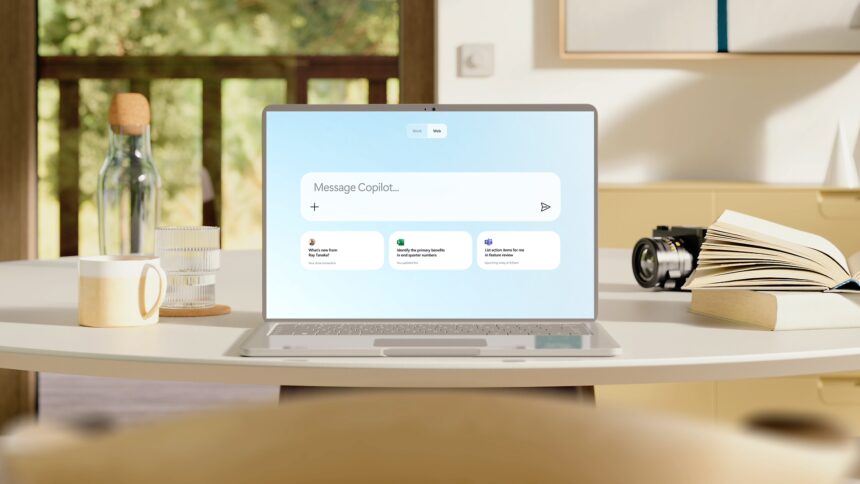
Windows 11 is no longer simply about adding another AI button or placing Copilot inside every application. Microsoft has already removed Copilot from some parts of Windows, including Photos and Snipping Tool, while the Copilot functionality in Notepad has been renamed “Writing tools.”
At the same time, Microsoft has been working on broader improvements to Windows fundamentals, including changes to personalization, search and the taskbar.
That suggests the company’s AI strategy is becoming less about making Windows itself look like a chatbot and more about making the operating system capable of supporting AI services underneath the surface.
The broader AI industry is also moving in this direction, with companies increasingly focusing on autonomous agents capable of completing tasks rather than simply responding to questions.
Microsoft appears to want Windows to be ready for that transition.
Windows Could Become a Platform for AI Agents
Microsoft’s IFA presentation also made it clear that AI agents are a major part of its Windows roadmap.
The company wants Windows to become “the best platform for AI,” with development, security and management capabilities designed around increasingly autonomous software.
One area of focus is improving the developer experience. Microsoft highlighted features such as Developer Mode and its efforts to make development workflows more integrated into Windows.
Security and control will become especially important as agents gain the ability to perform tasks on a user’s behalf.
Linton noted that businesses do not want autonomous agents operating without restrictions across corporate networks. Organizations need the ability to enforce policies while still taking advantage of long-running AI agents.
Future Windows releases could therefore provide administrators and users with more detailed controls over how these agents operate.
That could include the ability to audit agents, inspect their activity logs and control the actions they are allowed to perform.
Microsoft Is Building Infrastructure Around Local AI
Microsoft is also developing containers and subsystems intended to provide safer environments for AI workloads running on Windows.
The goal is to prevent an AI agent from having unrestricted access to personal files or other sensitive parts of a PC. Isolation could become increasingly important as agents move beyond generating text and begin interacting directly with applications, files and system resources.
Microsoft has promised to provide additional details later this year, but the broader direction is already becoming clearer.
Windows 11 is unlikely to become less focused on AI. Instead, Microsoft’s approach appears to be changing from AI as a visible Windows feature to Windows as infrastructure for AI.
That could ultimately make AI less noticeable to users while making it much more deeply integrated into the operating system.
Rather than another Copilot button, Microsoft’s long-term vision may be a Windows PC that can run powerful AI models locally, host autonomous agents and decide when a task should be handled on the device or in the cloud.