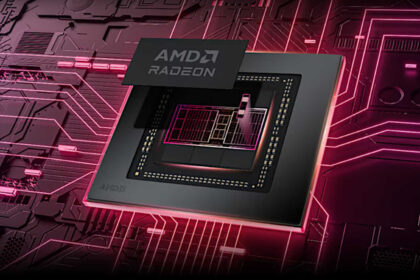

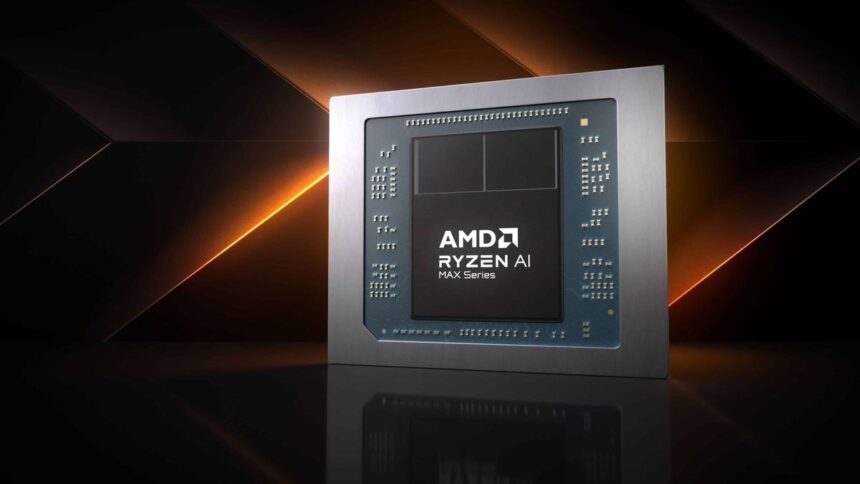
Advanced Micro Devices has officially unveiled its Ryzen AI Max Pro 400 series processors, putting an end to speculation surrounding the “Gorgon Halo” platform. The new mobile processors target premium AI-powered notebooks and professional workloads, bringing modest refinements over the previous Ryzen AI Max 300 “Strix Halo” lineup.
Built on AMD’s Zen 5 CPU architecture and paired with RDNA 3.5 integrated graphics, the Ryzen AI Max Pro 400 series arrives with support for up to 192GB of unified memory. This large memory capacity allows notebook manufacturers to dedicate as much as 160GB to video memory, a move expected to improve gaming performance, AI processing and professional computing tasks.
The lineup consists of three models: Ryzen AI Max+ Pro 495, Ryzen AI Max Pro 490 and Ryzen AI Max Pro 485. While the overall hardware design remains close to the previous generation, AMD has introduced improvements in AI processing, particularly in its flagship chip.
At the top of the stack sits the Ryzen AI Max+ Pro 495, equipped with 16 cores and 32 threads, reaching boost speeds of up to 5.2GHz.
The processor includes 80MB of total cache and delivers up to 55 TOPS of AI performance through its XDNA 2 neural processing unit, marking a noticeable improvement over its predecessor. It also features Radeon 8065S integrated graphics with 40 compute units based on RDNA 3.5 architecture.
The Ryzen AI Max Pro 490 has 12 cores and 24 threads, while the Ryzen AI Max Pro 485 has 8 cores and 16 threads. Both processors can boost to 5.0 GHz and deliver up to 50 TOPS of AI performance. They are paired with Radeon 8050S integrated graphics featuring 32 compute units.
AMD has emphasised local AI processing as a key focus of the Ryzen AI Max Pro 400 series. According to the company, notebooks powered by these processors will be able to handle large language models with more than 300 billion parameters while supporting multiple autonomous AI agents.
The combination of CPU, GPU and NPU resources is aimed at accelerating demanding AI tasks directly on devices without relying heavily on cloud processing.
Ryzen AI Max Pro 400 Series Specifications
| Model | Cores / Threads | Max Boost Clock | Total Cache | AI Performance (NPU) | Integrated Graphics | TDP |
|---|---|---|---|---|---|---|
| Ryzen AI Max+ Pro 495 | 16 / 32 | Up to 5.2GHz | 80MB | Up to 55 TOPS | Radeon 8065S (40 CUs) | 45W–120W |
| Ryzen AI Max Pro 490 | 12 / 24 | Up to 5.0GHz | 76MB | Up to 50 TOPS | Radeon 8050S (32 CUs) | 45W–120W |
| Ryzen AI Max Pro 485 | 8 / 16 | Up to 5.0GHz | 40MB | Up to 50 TOPS | Radeon 8050S (32 CUs) | 45W–120W |
Comparison With Previous Ryzen AI Max 300 Series
| Model | Cores / Threads | Max Boost Clock | Total Cache | AI Performance | Graphics | TDP |
|---|---|---|---|---|---|---|
| Ryzen AI Max+ Pro 395 | 16 / 32 | Up to 5.1GHz | 80MB | Up to 50 TOPS | Radeon 8060S (40 CUs) | 45W–120W |
| Ryzen AI Max Pro 390 | 12 / 24 | Up to 5.0GHz | 76MB | Up to 50 TOPS | Radeon 8050S (32 CUs) | 45W–120W |
| Ryzen AI Max Pro 380 | 8 / 16 | Up to 5.0GHz | 40MB | Up to 50 TOPS | Radeon 8050S (32 CUs) | 45W–120W |
The Ryzen AI Max Pro 400 processors feature a base TDP of 55W, though notebook makers will be able to configure power consumption between 45W and 120W depending on thermal design and performance targets.
While the refresh does not introduce major architectural changes, the Ryzen AI Max+ Pro 495 stands out with its improved AI capability and enhanced local processing power. Support for up to 192GB of unified memory across the entire lineup also positions the series for demanding AI workloads and high-performance computing applications.
The first notebooks powered by the Ryzen AI Max Pro 400 processors are expected to arrive in the third quarter from manufacturers including ASUS, HP and Lenovo.
Industry reports also suggest AMD may be preparing a standard Ryzen AI 500 series, which could adopt the newer RDNA 4 graphics architecture for future mobile platforms.