
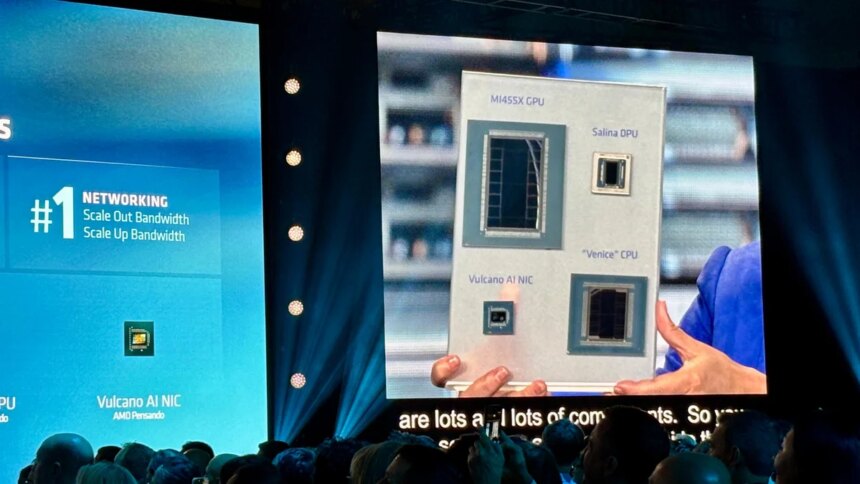
AMD has introduced its next generation of artificial intelligence accelerators with the launch of the Instinct MI400 GPU family during the Advancing AI 2026 event. The new lineup is designed for AI training, inference and high-performance computing (HPC), reinforcing the company’s push into the rapidly expanding data center AI market.
The Instinct MI400 family consists of two models, each targeting different enterprise and research workloads.
Instinct MI455X Targets AI Training and Inference
The flagship Instinct MI455X is built for large-scale AI applications, including model training, inference and the operation of AI data centers often referred to as “AI factories.”
Manufactured using a 2-nanometer process, the accelerator contains 320 billion transistors and supports FP4, FP6 and FP8 precision formats. These lower-precision data types are widely used in modern AI workloads because they deliver faster processing while maintaining sufficient accuracy for many machine learning tasks.
MI430X Focuses on Scientific Computing
AMD also announced the Instinct MI430X, a GPU aimed at high-performance computing and sovereign AI deployments.
Sovereign AI refers to AI infrastructure operated entirely under the control of governments or organisations, allowing sensitive models and data to remain within their own computing environments.
The MI430X delivers up to 288 teraflops (TFLOPS) of FP64 performance, making it suitable for scientific simulations, engineering applications and research workloads that require double-precision computing.
AMD Introduces Helios AI Platform
Alongside the new GPUs, AMD unveiled Helios, a rack-scale AI computing platform designed for large-scale AI deployments.
Each Helios system integrates 72 Instinct MI455X GPUs, creating a high-density platform for training and deploying advanced AI models.
According to AMD, Helios delivers:
- 15% higher FP4 performance than NVIDIA’s Vera Rubin NVL72 platform.
- 50% more memory capacity.
- Up to 30% more tokens per dollar, a metric commonly used to measure AI inference efficiency and operating costs.
Exaflop-Class Performance
AMD said the Helios platform is capable of reaching 2.9 exaflops of FP4 performance and 1.4 exaflops using FP8 precision.
These performance levels are intended for demanding AI workloads, where lower-precision arithmetic enables faster model training and inference while reducing computational overhead.
The platform also includes 31TB of HBM4 high-bandwidth memory, providing sufficient capacity to keep large AI models close to the GPUs. AMD said the system delivers an aggregate memory bandwidth of 1.7 petabytes per second, allowing massive volumes of data to move quickly between processors during AI computations.
Built Around AMD’s Data Center Ecosystem
Helios combines the new Instinct MI455X accelerators with 6th Generation AMD EPYC processors, the company’s ROCm software platform and networking technology based on Pensando architecture.
By integrating compute, networking and software into a single platform, AMD is positioning Helios as a complete solution for hyperscale AI deployments and enterprise data centers.