
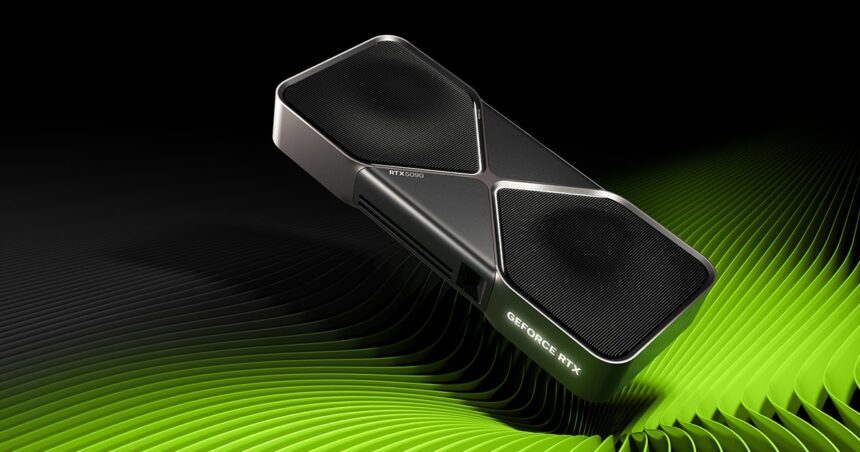
A GeForce RTX 5090 reportedly suffered a melted 16-pin power connector while its owner was testing Nvidia’s new DLSS 5 technology in NBA 2K27, raising fresh concerns about power consumption on the company’s flagship graphics card.
The incident was reported by HardOCP forum user “erek,” who said their MSI GeForce RTX 5090 Gaming Trio OC stopped functioning during testing. According to the user, the graphics card normally consumed around 450W during gaming. After DLSS 5 was enabled, however, power draw increased substantially.
Monitoring with GPU-Z reportedly showed the card drawing roughly 610W for an extended period. The highest recorded reading was 613.5W. That figure is significantly higher than the 575W power rating of the MSI RTX 5090 Gaming Trio OC.
The unusually high power draw is notable because DLSS 5 uses Nvidia’s new 3D-Guided Neural Rendering technology to generate and enhance visual details. While the technology is intended to improve image quality, the reported power figures suggest that some DLSS 5 workloads could place considerably more demand on high-end RTX 50-series GPUs.
It is important to note that the 613.5W reading represents the total board power, not the power delivered exclusively through the 16-pin connector. The PCIe slot can supply up to 75W, with the remaining power coming through the GPU’s external power connection.
The problem became apparent when the user noticed a burning smell coming from the system. After inspecting the power connection, they reportedly found that the plastic surrounding the 16-pin connector had melted and fused with the attached cable. Several pins were also said to have visible scorching, while part of the connector housing had melted away.
The cable involved in the incident was reportedly an MSI model with a yellow marking at the connector. The marking is intended to make it easier to confirm that the plug has been inserted completely, an issue that has received considerable attention since the introduction of high-power 16-pin GPU connectors.
However, the incident alone does not establish that DLSS 5 was responsible for the connector failure. RTX 5090 cards have experienced melted power connectors under other workloads, and previous cases have also pointed to factors such as poor insertion, improper connections or uneven contact between the connector and cable.
The higher power consumption associated with this particular DLSS 5 test could nevertheless have increased the electrical and thermal load on the connection. Running a graphics card above its rated power level for prolonged periods can place additional stress on both the card and its power delivery system.
For RTX 5090 owners, the report serves as another reminder to ensure that the 16-pin connector is fully seated and properly connected. Users running demanding workloads should also keep an eye on power consumption and inspect the connector if they notice unusual heat, discolouration, or a burning smell.