
As artificial intelligence evolves from passive chat interfaces into systems capable of taking real-world actions, industry leaders are increasingly concerned about fragmentation, proprietary lock-in, and inconsistent safety practices. Addressing those risks, the Linux Foundation has announced the formation of a new initiative: the Agentic AI Foundation (AAIF), a dedicated home for open-source technologies focused on AI agents.
The AAIF is designed to prevent a future in which agent-based AI systems splinter into incompatible ecosystems controlled by a small number of vendors. Instead, the foundation aims to establish shared standards, protocols, and best practices that allow AI agents to operate across platforms in a predictable, interoperable, and secure manner.
Major AI Players Commit Core Technologies
At launch, the AAIF is being anchored by significant contributions from Anthropic, Block, and OpenAI, each donating foundational components intended to serve as core infrastructure for agent-based systems.
- Anthropic is contributing to the Model Context Protocol (MCP), which provides a standardised way for AI models and agents to connect to external tools, data sources, and applications.
- Block, the fintech company behind Square and Cash App, is donating Goose, its open-source AI agent framework, which is already used internally by thousands of engineers for software development, analytics, and documentation.
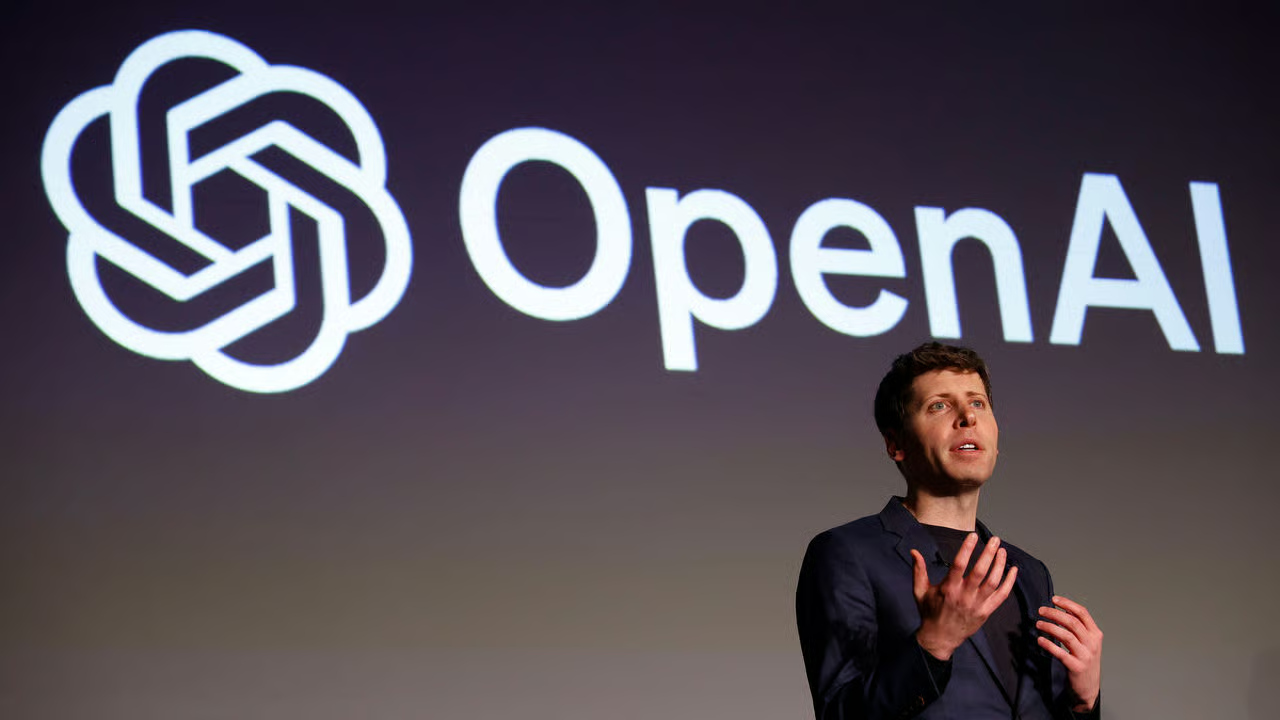
- OpenAI is donating AGENTS.md, a lightweight instruction file format that allows developers to define how AI-based coding tools should behave within a software repository.
Together, these technologies form what industry observers describe as the “plumbing” of the emerging agent ecosystem—basic components needed for AI systems to reason, act, and coordinate safely.
Broad Industry Support Signals Push for Interoperability
Beyond its founding contributors, the AAIF has attracted backing from a broad range of influential organisations, including AWS, Bloomberg, Cloudflare, and Google. Their involvement highlights a shared recognition that agent-based AI must scale responsibly, with common guardrails rather than isolated, proprietary approaches.
OpenAI engineer Nick Cooper emphasised that technical protocols function as a shared language between systems, enabling agents to collaborate without developers rebuilding integrations for every platform.
“We need multiple protocols to negotiate, communicate, and work together to deliver value,” Cooper said, adding that the future of AI agents will not belong to a single company or ecosystem.
Avoiding a ‘Walled-Garden’ Agent Future
Jim Zemlin, Executive Director of the Linux Foundation, has framed the AAIF as a direct response to concerns about closed, vertically integrated AI platforms. According to Zemlin, without coordinated standards, developers could face an environment where agent behavior, orchestration, and tool access are tightly constrained by vendor-specific implementations.
By bringing projects like MCP, Goose, and AGENTS.md together, the foundation aims to align interoperability efforts, define shared safety patterns, and reduce duplication across the industry. Zemlin noted that AAIF is explicitly focused on agent orchestration and coordination—areas that existing foundations and working groups do not fully address.
Why Block Is Betting on Open Agents
Although Block is better known for payments and consumer finance tools than AI infrastructure, the company sees Goose as proof that open frameworks can compete with proprietary solutions at scale. According to Brad Axen, Block’s AI technical lead, open sourcing Goose allows external contributors to strengthen the tool while ensuring improvements flow back into Block’s own engineering efforts.
Donating Goose to the Linux Foundation also places it within a larger ecosystem of shared components, positioning it as a practical example of how agent frameworks can integrate with common protocols like MCP.
Making MCP Neutral and Vendor-Agnostic
Anthropic’s decision to donate MCP is similarly strategic. By placing the protocol under neutral governance, Anthropic aims to ensure it is not perceived as being controlled by any single vendor.
MCP co-creator David Soria Parra explained that widespread adoption is the ultimate goal. A common integration layer would enable developers to build once and deploy across multiple AI clients, eliminating the need for numerous custom adapters.
Governance, Funding, and Long-Term Viability
The AAIF operates under a directed fund model, allowing companies to contribute financially through membership dues. However, the Linux Foundation maintains that funding does not equal control. Technical steering committees, rather than corporate sponsors, are responsible for setting project direction and roadmaps.
Still, questions remain about whether AAIF will mature into essential industry infrastructure or fade into a symbolic alliance. Zemlin said early signs of success would include vendors adopting shared standards in production agents and extending them collaboratively over time.
Cooper echoed that sentiment, emphasising that the foundation’s standards must remain dynamic rather than static artefacts.
In the near term, AAIF promises tangible benefits: reduced time spent building custom integrations, more consistent agent behaviour across environments, and simpler deployment in regulated or security-sensitive settings.
In the longer term, the foundation’s ambitions are broader. If its technologies become widely adopted, AI agents could evolve in an open, modular ecosystem similar to the one that shaped the modern web—where systems interoperate by default and innovation is driven by shared standards rather than locked platforms.
Whether the Agentic AI Foundation can achieve that vision will depend on adoption, execution, and sustained collaboration. For now, its launch marks a clear signal that major players see openness, not isolation, as the path forward for agent-driven AI.