
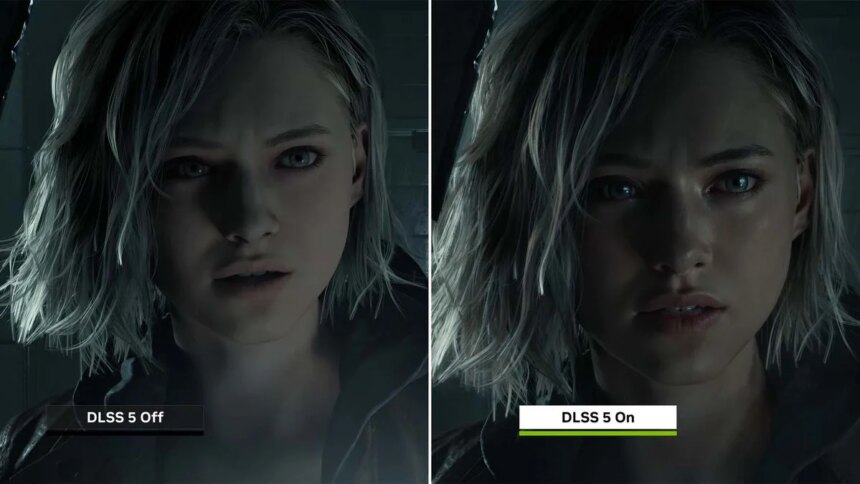
NVIDIA has provided new details about DLSS 5 following criticism from developers and gamers over its initial unveiling. During SIGGRAPH, the company outlined how its next-generation rendering technology is designed to enhance game visuals while giving developers greater control over the final appearance of their projects.
The clarification comes after the first demonstration of DLSS 5 raised concerns that the technology significantly altered the artistic style of games rather than simply improving image quality.
According to NVIDIA, DLSS 5 operates as a generative rendering stage applied after the game’s traditional rendering pipeline.
The game engine and GPU continue to handle essential tasks such as geometry, scene composition and primary lighting. Once that process is complete, the AI model refines visual elements including materials, reflections, ambient occlusion and shadow quality.
NVIDIA says this approach allows developers to improve visual fidelity without replacing the core rendering performed by the game engine.
Three AI Models for Different Visual Styles
To provide greater flexibility, DLSS 5 includes three separate generative models: Model A, Model B, and Model C.
Each model has been trained with different parameters, allowing developers to select the version best suited for specific environments or lighting conditions, such as indoor scenes, outdoor environments or cinematic sequences.
The goal is to preserve the intended artistic direction while leveraging AI-based image enhancement.
Object-Level Controls Introduced
One of the most significant additions is support for per-object masking.
Developers will be able to determine exactly which parts of a scene receive AI enhancements. For example, DLSS 5 can be applied to environmental assets while being completely disabled for character faces, ensuring facial details and expressions remain faithful to the original artwork.
This level of control is intended to address concerns that AI-generated enhancements could unintentionally modify important visual elements.
Adjustable Materials, Shadows and Lighting
DLSS 5 also introduces tools that allow developers to fine-tune specific rendering characteristics.
The technology can adjust surface details, contact shadows and reflections, while additional controls allow changes to overall lighting, global illumination and color tone. These options give developers the ability to customize how aggressively AI enhancements are applied across different scenes.
Designed for Low Latency
NVIDIA stated that DLSS 5 processes one frame at a time, eliminating the need to predict future frames. The technology also uses motion vectors to minimize image flickering and improve visual stability during gameplay.
The company added that the system has been optimized to operate efficiently on a single graphics card while managing video memory effectively.
NVIDIA has not yet confirmed which graphics cards will support DLSS 5, and compatibility across the entire GeForce RTX 50 Series has not yet been clarified.
NVIDIA plans to release DLSS 5 during the next quarter, bringing its latest AI-powered rendering technology to supported games.