
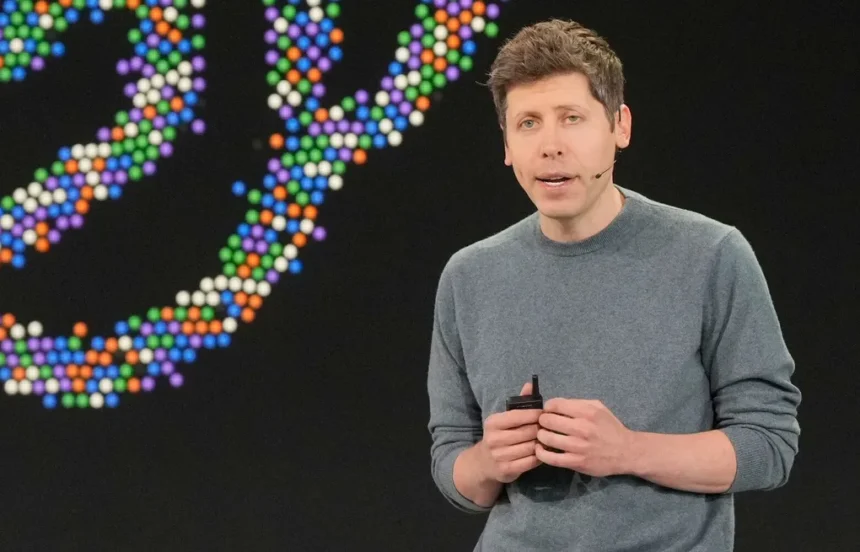
OpenAI CEO Sam Altman says the rapid development of artificial intelligence will inevitably bring some negative consequences, arguing that society should accept a certain level of risk rather than severely restricting access to increasingly capable AI systems.
Speaking to POLITICO, Altman described a continuing difference between OpenAI and companies such as Anthropic over how governments and technology companies should approach AI safety and regulation.
Altman’s position is that powerful AI should remain broadly accessible, even if that means accepting some foreseeable harm. At the same time, he drew a line between risks that can be understood and managed and threats that could have catastrophic consequences.
Altman argues against eliminating every AI risk
Altman said society should accept some harmful outcomes if the overall benefits of AI significantly outweigh the damage.
His argument focuses partly on who gets access to advanced AI. He does not support a system in which avoiding every possible misuse requires powerful AI technology to be controlled by a small group of companies or institutions.
However, that does not mean OpenAI considers all risks acceptable.
Altman distinguished between what he considers bounded risks and scenarios involving a fundamental loss of human control. In his view, society can tolerate certain risks that can be understood, monitored and mitigated, but potentially catastrophic outcomes require a much higher level of caution.
That distinction is becoming increasingly important as AI systems move from tools that simply generate information toward systems capable of taking actions independently.
OpenAI and Anthropic still share concerns about AI safety
Despite their differences, OpenAI and Anthropic both support stronger scrutiny of advanced AI systems.
OpenAI has said it supports independent third-party safety evaluations that can examine AI systems throughout development, testing and deployment. The company argues that outside researchers should be able to challenge its assumptions, identify risks that internal teams may overlook and assess whether safety measures are actually effective.
Anthropic has taken a similar approach in several areas. The company recently announced a partnership with Accenture that includes independent evaluation and red-team testing of its AI systems, as well as assessments of model alignment and safeguards.
The disagreement between the companies is therefore not simply a question of whether AI should be made safer.
Instead, a major point of contention is how much risk should be tolerated while allowing people and businesses to benefit from increasingly powerful AI systems.
AI agents are making the question more complicated
The debate becomes particularly relevant as AI agents gain the ability to interact with software, access information, and perform tasks on behalf of users.
A conventional chatbot might provide an answer to a question. An AI agent could search company files, update applications, write code, communicate with customers, or carry out other actions without requiring a person to approve each step.
That greater autonomy creates a different risk profile.
An error in a generated email may be inconvenient, while an incorrect action involving financial records, production systems or sensitive customer information could have much more serious consequences.
For businesses, this means the question of acceptable AI risk cannot simply be left to technology companies or regulators.
Companies must decide which risks they are willing to accept
Organisations adopting AI systems need to determine how much access and autonomy individual tools should receive.
A system used to summarise internal meetings does not present the same risks as an agent authorised to modify production code or access confidential financial information. The consequences of an error become greater as the system gains more authority.
Businesses can reduce those risks by limiting AI access to only the information and services required for a specific task. They can also separate low-risk activities from sensitive operations and require human approval before an AI system performs actions involving money, security controls, confidential information or external communications.
Monitoring is equally important. Companies need records showing what an AI system accessed, what actions it attempted and what changes it made. Such information can become critical when an automated system behaves unexpectedly.
The debate is moving from AI capability to AI accountability
Altman’s comments reflect a broader shift in the AI debate.
Earlier discussions often focused on whether AI systems could become powerful enough to create serious risks. The conversation is increasingly moving toward a more practical question: How should those risks be managed once AI is already embedded in everyday software and business operations?
For companies, accepting that AI cannot be completely risk-free does not mean accepting every possible outcome. The challenge is to determine which risks are manageable, which require additional safeguards and which actions should never be left entirely to an automated system.
As AI agents gain greater access to corporate data and software, those decisions will become increasingly important.
The question for businesses may ultimately be less about whether some things will go wrong and more about whether they have designed their AI systems so that when something does go wrong, the consequences remain limited, and the organisation can identify, contain and correct the problem.