

Emojis have become integral to Internet communication, and it isn’t easy to imagine a world without them. However, before their widespread use, people relied on emoticons to convey their feelings in text-based communication.
Despite the similarities in names, there are distinct differences between the two forms of expression.
What is an emoticon?
Emoticons express feelings through characters such as letters, numbers, and punctuation marks. The word “emoticon” comes from the combination of “emotion” and “icon.” The first recorded use of emoticons dates back to 1982 when Professor Scott Fahlman suggested using 🙂 for jokes and 🙁 for serious news on an online Carnegie Mellon University in Pittsburgh, USA discussion board.
Since then, emoticons have become popular to complement messages on various text platforms like SMS and email. Users have created new expressions through creativity, and emoticons have become ubiquitous in Internet communication.
What is an emoji?
Emojis are graphic symbols that convey various emotions, objects, colors, animals, and more. Unlike emoticons, they are not created using a combination of characters but are represented by a unique character.
These pictograms are included in the Unicode standard, used by various operating systems and applications globally, and accessed via dedicated computer, smartphone, and tablet keyboards.
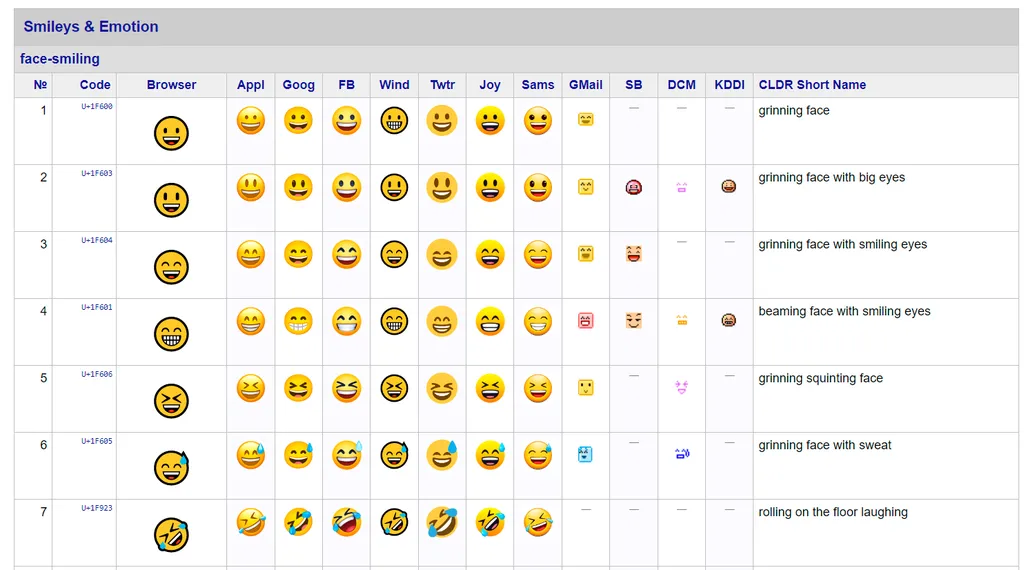
The term “emoji” comes from the Japanese words “e” and “Moji,” which mean “image” and “character,” respectively. Designer Shigetaka Kurita created the initial icons set between 1998 and 1999 for the Japanese mobile phone company NTT DoCoMo. The software was targeted at teenagers and included support for pictograms.
The first symbol used was a heart, and the original set of 176 emojis is now displayed at the Museum of Modern Art in New York. These emojis are widely used worldwide and available on a special keyboard provided by the Unicode standard, which various operating systems and applications adopt.
Emoji keyboards include a range of elements of Japanese culture, such as a Shinto temple (⛩️), paper lanterns (🏮), Japanese dolls (🎎), the map of Japan (🗾), and some ideograms for “here” (🈁), “secret” (㊙️), and “forbidden” (🈲).
This is due to the fact that the word “emoji” has Japanese roots, combining “e” and “Moji” which translate to “image” and “character,” respectively.
What is the difference between emoticons and emojis?
The distinction between emojis and emoticons lies in their formats. Emoticons are created using a combination of characters and primarily to convey emotions in text. On the other hand, emojis are small images that are inserted into the message using a special character.
In simpler terms, emoticons require the user to type out a string of characters on the keyboard, whereas emojis can be accessed by opening a list and selecting the desired icon. With the widespread adoption of the Unicode standard, emoticons have become less popular. However, they remain a universal option for expressing emotions, especially on older devices that do not support emoji pictograms.
It is important to note that emojis and emoticons can coexist on some messaging platforms. For instance, on some platforms, typing “:-(“ will be automatically replaced by a smiley emoji.