

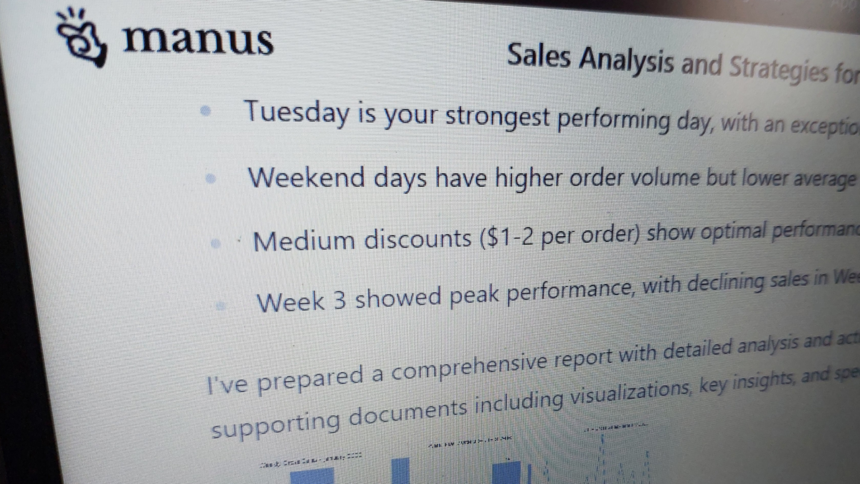
Manus AI is a Chinese autonomous AI agent designed to handle complex tasks with minimal human input. Unlike traditional chatbots that respond step by step, Manus can independently carry out long research processes, generate written content, build spreadsheets, and even write code-using what the developers describe as a virtual computer environment.
The team behind Manus describes it as the “first general AI agent,” positioning the platform as an early glimpse into what artificial general intelligence (AGI) could eventually become. In this vision, AI wouldn’t only respond to instructions but also reason, plan, and execute tasks in a manner that more closely resembles human problem-solving.
The tool gained widespread attention in March 2025, quickly going viral and marking one of China’s first major entries into the global AI agent race. Below is a closer look at how Manus AI works, its capabilities, and how users can access it.
How does Manus AI work?
Manus AI operates in the same general category as advanced research agents, such as Deep Research and Operator, which are tools designed to handle multi-step reasoning and large-scale analysis. Instead of responding with a single answer, Manus is designed to execute an entire workflow independently.
The idea is simple: the user submits one detailed prompt, and Manus takes over from there. After receiving a request, the system opens a cloud-based virtual machine and begins working in real-time. It browses websites, analyses documents, opens files, runs scripts, and gathers information until it reaches a final result.
What sets Manus apart is transparency. The interface shows the entire reasoning process, including:
- Which searches were performed
- Which websites were visited
- What files were created or modified
- How conclusions were reached
Once the task is complete, Manus provides a list of all generated files. Reports can be saved as PDFs, while technical tasks allow users to review and export code written in Python or other programming languages.
According to co-founder and chief scientist Yichao Ji, Manus AI is designed to continuously generate ideas and refine results rather than stopping at the first acceptable answer. Since the virtual computer runs in the cloud, users can even close their device while Manus continues working without losing progress.
What can Manus AI do?
Manus AI is built for a wide range of professional and analytical tasks. Some practical use cases include:
- Analysing websites, documents, compressed files (including ZIP archives), and source code
- Reviewing resumes and generating ranked candidate lists for job openings
- Creating charts, dashboards, and even full websites to visualize data interactively
- Planning travel itineraries or suggesting neighbourhoods to live in based on budget and preferences
- Conducting market research and competitive analysis
- Comparing insurance plans and generating tables with pricing, coverage, and key differences
Because Manus can both research and execute technical steps, it blurs the line between assistant, analyst, and operator.
How to use Manus AI
Currently, Manus AI is in a preview phase with restricted access. New users need an invitation, which is currently distributed through the project’s Discord community. This limited rollout allows the developers to test the platform at scale while refining its capabilities.
For those without access, the official website (manus.im) offers demonstrations and sample workflows that showcase the AI agent in action, providing a clear understanding of how it autonomously performs complex tasks.
Why Manus AI matters
Manus AI represents a broader shift in artificial intelligence-from tools that simply respond to prompts to agents that can plan, act, and deliver complete outcomes independently. While it’s still early, the platform highlights how AI agents could soon handle entire projects end-to-end, changing how people approach research, data analysis, and productivity work.
Whether it truly becomes a stepping stone toward AGI remains to be seen, but Manus AI has already positioned itself as one of the most ambitious autonomous AI systems to emerge from China so far.