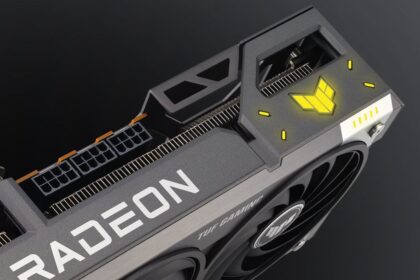

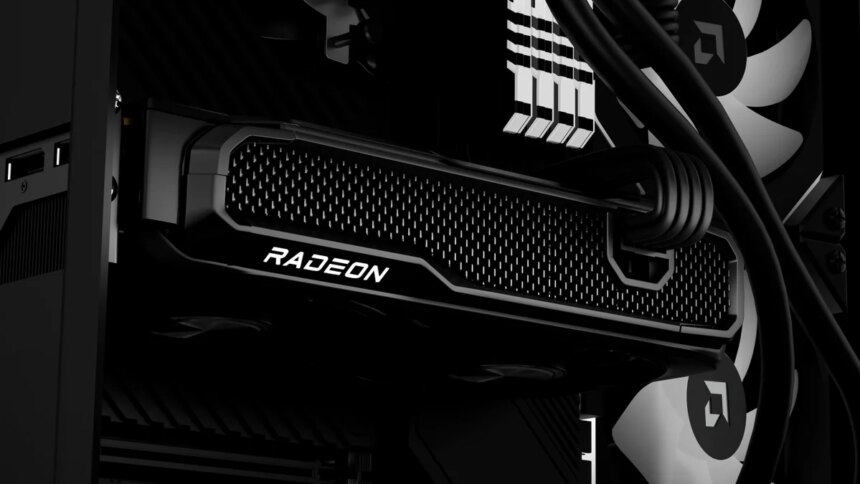
AMD has officially detailed a 4GB version of its Radeon RX 9050, confirming that the reduced-memory model includes more significant changes than simply cutting the VRAM.
The graphics card is intended exclusively for OEMs and system integrators, not the DIY retail market. According to AMD’s specifications, the 4GB model uses a 64-bit memory interface, half the width of the 128-bit bus found on the standard 8GB RX 9050.
The reduction also cuts memory bandwidth from 224 GB/s to 112 GB/s.
4GB model gets major memory cuts
The Radeon RX 9050 4GB is based on the same Navi 48 GPU architecture and RDNA 4 design as its 8GB counterpart. It retains 1,792 stream processors and 28 Compute Units, while its game and boost clocks remain at 2.2GHz and 2.6GHz, respectively.
The biggest differences are found in the memory subsystem.
AMD equips the OEM model with 4GB of GDDR6 memory and a 64-bit bus. The 8GB version uses 8GB of GDDR6 connected through a 128-bit interface.
As a result, available memory bandwidth is halved. The 8GB RX 9050 reaches 224 GB/s, while the 4GB model is limited to 112 GB/s.
AMD has also reduced the amount of Infinity Cache. The 8GB card features 32MB of L3 cache, while the 4GB version has only 16MB.
Despite these reductions, the core configuration and clock speeds remain unchanged.
| Specification | Radeon RX 9050 8GB | Radeon RX 9050 4GB |
|---|---|---|
| GPU | Navi 48 / RDNA 4 | Navi 48 / RDNA 4 |
| Stream Processors | 1,792 | 1,792 |
| Compute Units | 28 | 28 |
| Game Clock | 2,200 MHz | 2,200 MHz |
| Boost Clock | 2,600 MHz | 2,600 MHz |
| Memory | 8GB GDDR6 | 4GB GDDR6 |
| Memory Interface | 128-bit | 64-bit |
| Memory Bandwidth | 224 GB/s | 112 GB/s |
| Infinity Cache | 32MB | 16MB |
| TBP | 130W | 100W |
| Market | Retail and OEM | OEM only |
Why AMD is keeping the 4GB version out of retail
The decision to limit the 4GB RX 9050 to pre-built systems is understandable given the demands of modern games.
Four gigabytes of VRAM has become increasingly restrictive, particularly when playing newer titles at 1080p. A narrower memory bus and lower bandwidth could further limit performance when the GPU needs to move large amounts of texture and graphics data.
Upscaling technologies such as AMD’s FSR can reduce rendering workloads, but they cannot increase the physical amount of VRAM available to a graphics card.
The combination of 4GB of memory, a 64-bit bus and 112 GB/s of bandwidth therefore makes the card more suited to basic gaming and entry-level systems than demanding modern releases.
AMD has used similar configurations before
This is not the first time AMD has created a graphics card with heavily reduced memory specifications for low-cost systems.
The company previously adopted a similar approach with products such as the Radeon RX 6400 and RX 6500 XT. Those cards were designed around cost-conscious configurations, with compromises in memory capacity and bandwidth to keep entry-level systems affordable.
The RX 9050 4GB follows a similar philosophy, although its OEM-only availability means consumers building their own PCs will not have the option of purchasing the cut-down model as a standalone retail product.
For DIY buyers, the 8GB Radeon RX 9050 remains the official entry-level option.