
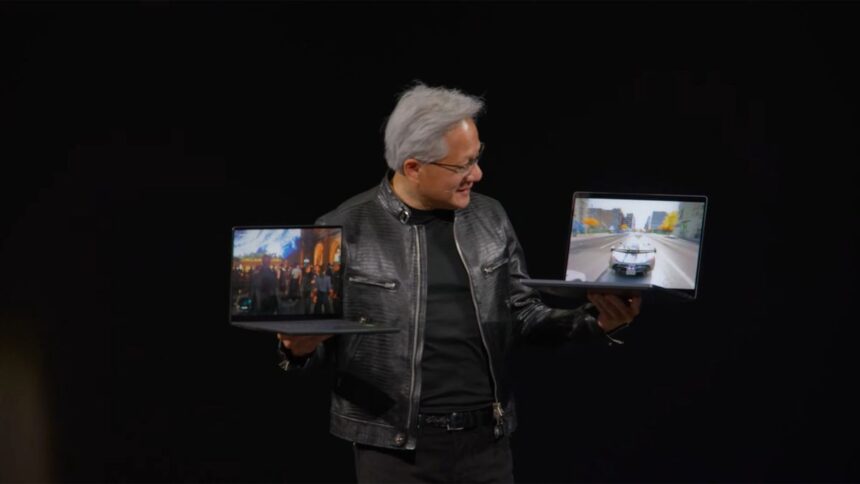
At Computex 2026, NVIDIA officially entered the consumer CPU market with the launch of RTX Spark, a new Arm-based processor developed in collaboration with MediaTek. After months of speculation and leaks, the company confirmed the chip as its first integrated CPU-GPU platform designed for mainstream notebooks, positioning it as a direct challenger to Intel, Advanced Micro Devices, Qualcomm, and Apple.
Built using TSMC’s 3nm manufacturing process, RTX Spark combines NVIDIA’s Grace CPU architecture with Blackwell graphics technology in a single package. The company is positioning the chip as the foundation of a new generation of AI-powered PCs capable of handling advanced workloads locally rather than relying heavily on cloud services.
At the heart of RTX Spark is a 20-core Grace-based processor focused on power efficiency, paired with a Blackwell GPU featuring 6,144 CUDA cores. NVIDIA claims the platform can deliver up to 1 petaflop of AI performance in FP4 precision, placing AI processing at the center of the product’s design.
One of the chip’s standout specifications is support for up to 128GB of unified LPDDR5X memory with bandwidth reaching 600GB/s. The unified memory architecture allows the CPU, GPU and AI workloads to access the same memory pool, improving efficiency for large-scale computing tasks.
RTX Spark Key Specifications
| Specification | RTX Spark |
|---|---|
| CPU Architecture | Grace |
| CPU Cores | 20 Cores |
| GPU Architecture | Blackwell |
| CUDA Cores | 6,144 |
| AI Performance | Up to 1 PFLOP (FP4) |
| Memory Support | Up to 128GB LPDDR5X Unified Memory |
| Memory Bandwidth | 600GB/s |
| Manufacturing Process | 3nm |
| Architecture | Arm |
| Development Partner | MediaTek |
Built for Local AI Workloads
According to NVIDIA, RTX Spark can run AI models and autonomous agents with up to 120 billion parameters directly on the device. This capability is intended to reduce dependence on cloud infrastructure while enabling faster response times and greater privacy for AI-powered applications.
During the launch presentation, Jensen Huang described the product as a major evolution of the personal computer.
“The PC is being reinvented. For 40 years, you opened apps, clicked and typed. With RTX Spark and Windows, you ask and the PC does the work,” Huang said during the keynote presentation.
NVIDIA says RTX Spark combines the company’s major technologies, including CUDA, RTX graphics and its AI software ecosystem, into a single platform capable of handling AI workloads, creative applications and gaming.
Gaming Performance Demonstrated on Battery Power
While AI was the primary focus of the announcement, NVIDIA also showcased gaming capabilities. The company demonstrated several AAA titles running at 1440p resolution and approximately 100 frames per second while operating on battery power.
Although NVIDIA did not provide complete testing details, technologies such as DLSS are expected to play a significant role in achieving those performance levels on a mobile platform.
The demonstration suggests RTX Spark is designed to compete not only in AI productivity but also in gaming and content creation, areas traditionally dominated by discrete graphics solutions.
Future Roadmap Includes Rubin and Feynman Generations
Looking beyond RTX Spark, Huang revealed that NVIDIA plans to continue expanding its Arm-based PC platform throughout the decade.
The company intends to introduce two future generations based on the Rubin and Feynman architectures. These upcoming platforms are expected to adopt next-generation LPDDR6 memory and eventually integrate HBM technology, significantly increasing memory bandwidth and AI processing capabilities.
First Devices Arriving in 2026
The first notebooks and mini PCs powered by RTX Spark are scheduled to launch during the 2026 product cycle. Manufacturing partners include ASUS, Dell Technologies, HP, Lenovo, MSI and Microsoft.
NVIDIA has not clarified whether RTX Spark will eventually replace traditional GeForce mobile graphics solutions in certain laptop segments. However, the launch signals a major strategic expansion beyond standalone GPUs and into fully integrated computing platforms.
With RTX Spark, NVIDIA is making its most ambitious move yet into the PC processor market, aiming to redefine notebooks around AI, unified computing and Arm-based efficiency.